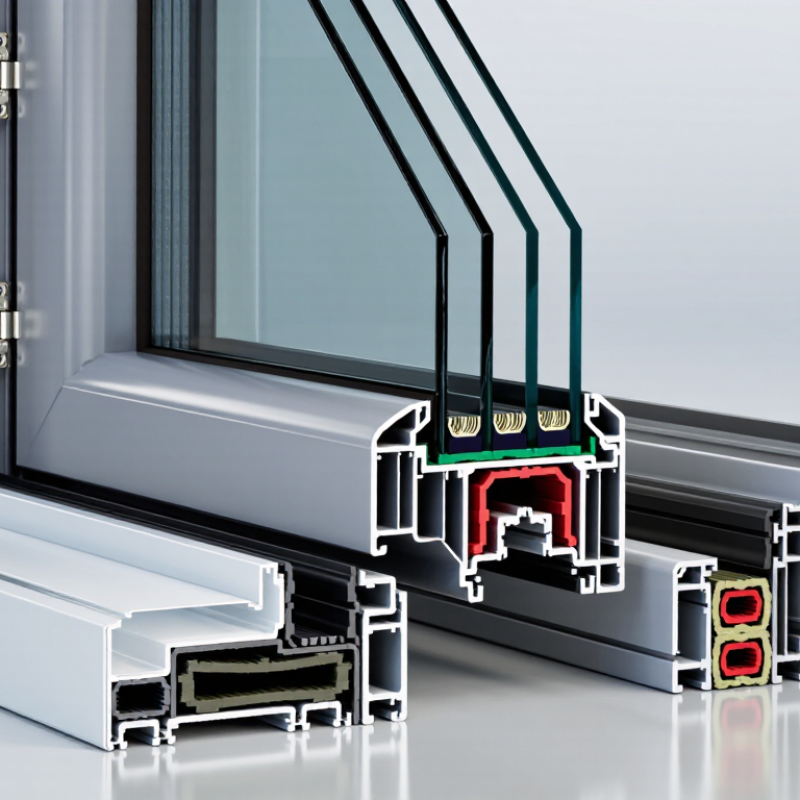
| Definition | Extruded aluminium section | A window aluminium profile is a shaped section made by forcing a heated aluminium billet through a steel die. Its cross-sectional geometry is designed to form part of a window, door, curtain wall, or glazing system. |
| Common Aluminium Alloys | 6060 and 6063 | These heat-treatable alloys are widely used for architectural profiles because they offer good extrudability, surface finish, corrosion resistance, and adequate strength for many window applications. |
| Typical Temper Conditions | T5 or T6 | T5 profiles are cooled after extrusion and artificially aged. T6 profiles receive a solution heat treatment followed by artificial aging, generally providing higher mechanical strength than T5. |
| Basic Window Components | Frame, sash, mullion, transom, glazing bead, and interlock | Different profiles perform different structural or functional roles. Frames hold the window in the opening, sashes hold movable glass panels, and glazing beads secure the glass and gaskets. |
| Manufacturing Stage 1 | Billet preparation | Aluminium billets are cut to length and heated to a controlled extrusion temperature. The billet must be sufficiently soft for forming while maintaining suitable metallurgical properties. |
| Manufacturing Stage 2 | Die design and production | A hardened steel die creates the required hollow or solid cross-section. Bridge, porthole, and seam-welded dies may be used for profiles containing internal cavities. |
| Manufacturing Stage 3 | Hot extrusion | The press pushes the heated billet through the die. The emerging profile is guided, cooled, stretched to reduce distortion, and cut into standard production lengths. |
| Manufacturing Stage 4 | Heat treatment and aging | Depending on the specified temper, the profile may be artificially aged to improve hardness, yield strength, dimensional stability, and resistance to deformation during use. |
| Surface Finishing | Anodizing, powder coating, or liquid coating | Anodizing creates a controlled oxide layer, while powder coating applies a durable polymer finish. Surface treatment improves appearance and provides additional protection against weathering and corrosion. |
| Typical Profile Wall Thickness | Approximately 1.2–2.5 mm for many window sections | The actual thickness depends on structural loads, profile geometry, span, glass weight, wind pressure, and the applicable design standard. Heavy-duty systems may use thicker sections. |
| Thermal Performance | Non-thermal-break or thermally broken | Standard aluminium conducts heat efficiently. A thermal-break system uses a low-conductivity polyamide strip between the interior and exterior aluminium sections to reduce heat transfer and surface condensation. |
| Thermal-Break Material | Glass-fibre-reinforced polyamide | Polyamide strips are mechanically locked into specially designed aluminium sections. The width of the thermal break varies by system and affects insulation performance. |
| Window Opening Types | Fixed, casement, awning, sliding, tilt-and-turn, and folding | Profile geometry is adapted to the movement and hardware requirements of each opening type. Sliding systems commonly use tracks, rollers, interlocks, and dedicated meeting stiles. |
| Glazing Compatibility | Single, double, or triple glazing | Glazing rebates and beads must match the glass thickness and gasket arrangement. Modern systems may accommodate insulated glass units with air or inert-gas cavities. |
| Sealing Method | EPDM, silicone, or other approved gaskets | Gaskets create compression seals around the glass and between moving or fixed profile sections. Correct gasket placement is essential for air tightness and water resistance. |
| Key Performance Factors | Strength, air permeability, water tightness, and wind resistance | Window performance depends on the complete system, including profiles, corners, hardware, seals, glass, drainage paths, fabrication quality, and installation conditions. |
| Drainage Design | Weep holes and internal drainage channels | Small drainage openings allow infiltrated water to move through the profile and discharge to the exterior. Drainage paths must remain correctly positioned and free from blockage. |
| Dimensional Control | Profile straightness, twist, wall thickness, and cut length | Manufacturers inspect dimensions after extrusion and finishing to ensure that profiles fit corner joints, gaskets, hardware, glazing components, and installation tolerances. |
| Typical Finished Length | Often around 5–7 metres | Standard extrusion lengths vary according to press capacity, profile shape, transport requirements, and fabrication plans. Profiles are later cut to the dimensions required for assembly. |
| Primary Advantages | Low weight, corrosion resistance, rigidity, and recyclability | Aluminium profiles can provide slim sightlines and durable frames with relatively low maintenance. Aluminium can also be recycled repeatedly while retaining much of its material value. |
| Quality Checks | Visual inspection, dimensional measurement, coating checks, and mechanical testing | Common checks include surface appearance, colour consistency, profile dimensions, coating thickness, hardness, tensile properties, and the fit of assembled components. |
| Installation Considerations | Anchoring, perimeter sealing, alignment, and thermal movement | Frames must be correctly aligned and securely fixed. Perimeter joints require suitable weather seals, and allowances may be needed for the thermal expansion of aluminium. |