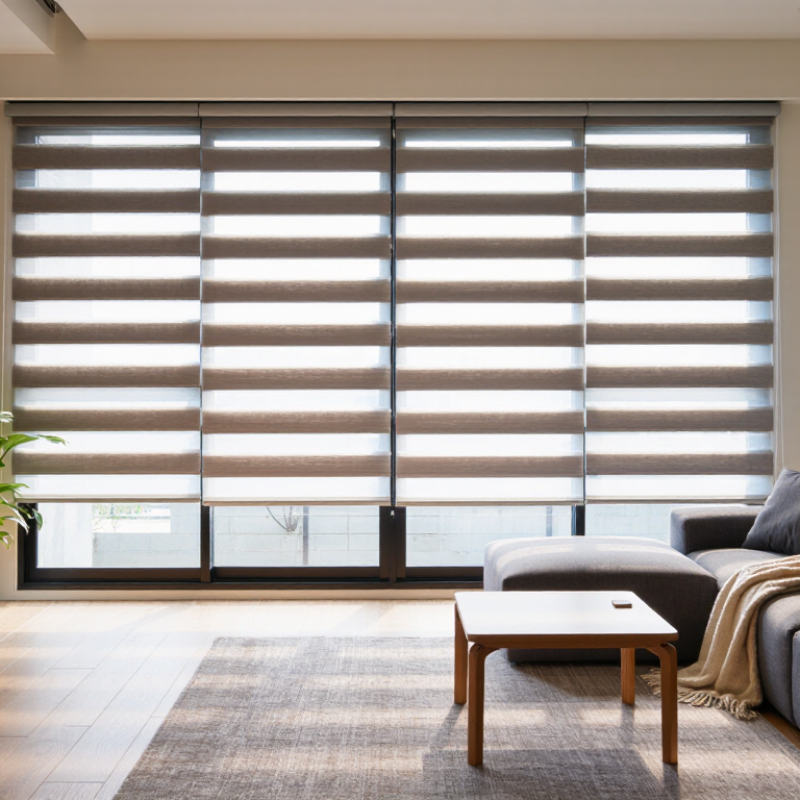
| Basic Construction | Alternating sheer and opaque horizontal fabric bands | The front and rear bands align or overlap as the shade is adjusted | Provides more flexible light and privacy control than a single-layer shade |
| Most Common Material | Polyester fabric | Lightweight, dimensionally stable, and available in woven or textured finishes | Offers a broad combination of appearance, durability, and easy maintenance |
| Alternative Material | Polyester blend or coated textile | May combine polyester with other fibers or a surface coating for added structure or shading | Creates more options for texture, opacity, and room-specific performance |
| Sheer Band | Open-weave or translucent fabric | Filters daylight while maintaining some outward visibility when the bands are aligned | Softens glare and helps rooms feel brighter without fully opening the blind |
| Opaque Band | Tightly woven or room-darkening fabric | Reduces incoming daylight and limits visibility through the covered sections | Improves privacy and is useful for bedrooms, media rooms, and nurseries |
| Light-Control Positions | Open, filtered, and closed | Band alignment changes the proportion of sheer and opaque fabric across the window | Supports different needs throughout the day without replacing the window covering |
| Privacy Level | Adjustable from moderate to high | Privacy depends on band position, fabric opacity, interior lighting, and the time of day | Allows homeowners to balance daylight with privacy more precisely |
| Color Families | White, ivory, beige, gray, taupe, charcoal, and muted colors | Neutral shades are widely used; darker colors generally create stronger visual contrast | Coordinates easily with modern walls, flooring, furniture, and metal finishes |
| Color Selection Tip | Light shades for an airy look; medium or dark shades for contrast | Actual appearance varies with natural light, artificial lighting, and screen settings | Sample swatches help homeowners evaluate color and texture in the intended room |
| Operating Methods | Continuous loop, cordless, or motorized operation | Availability depends on the blind design, window size, installation requirements, and local safety rules | Provides choices for convenience, child safety, accessibility, and hard-to-reach windows |
| Motorized Features | Remote control, wall control, timer, or smart-home integration | Requires compatible hardware and, for some systems, a power source or rechargeable battery | Makes daily adjustment easier and can support scheduled light management |
| Room Suitability | Living rooms, bedrooms, offices, dining areas, and guest rooms | Select moisture-resistant materials carefully for kitchens and bathrooms | Works across many interior styles while allowing room-by-room light control |
| Maintenance | Regular dusting and gentle spot cleaning | Use a soft brush, vacuum with a suitable attachment, or a slightly damp cloth; follow the care label | Helps preserve the fabric surface and keeps the alternating bands looking even |
| Window-Fit Options | Inside mount or outside mount | Inside mounting fits within the frame; outside mounting covers part of the wall around the window | Supports a clean built-in appearance or broader light and privacy coverage |
| Best Overall Advantage | One shade with adjustable visual openness | Combines sheer daylight filtering with opaque privacy bands in a layered design | Offers a modern appearance, flexible control, and multiple material and color choices |