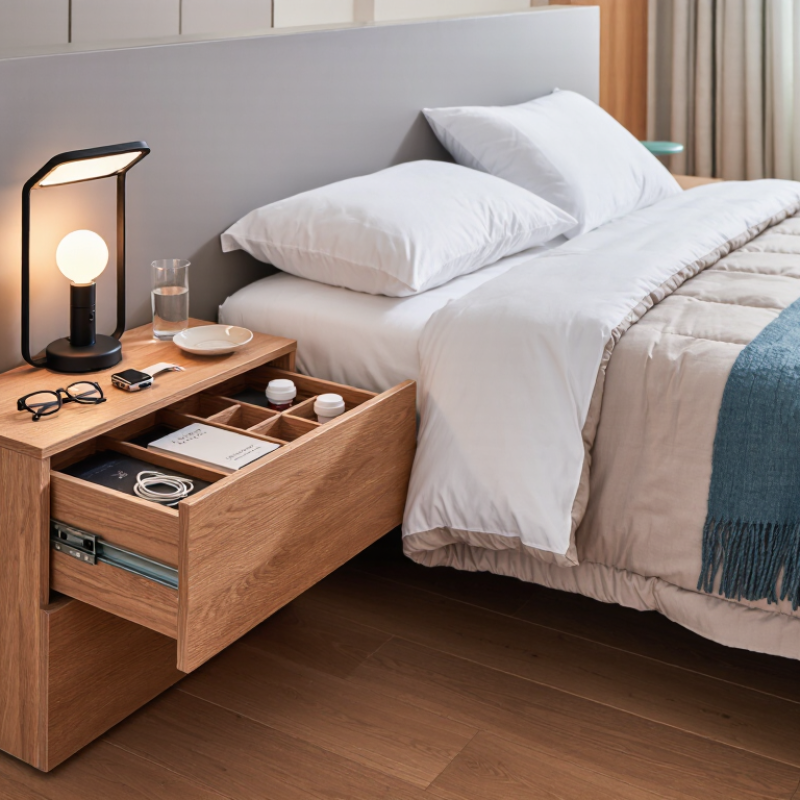
| Primary function | Bedside storage for personal and nighttime essentials | Keeps frequently used items within arm’s reach | Reduces clutter on the bed, floor, and surrounding surfaces |
| Typical width | 40–60 cm | Suitable for most standard bedroom layouts | Provides useful storage without taking up excessive floor space |
| Typical depth | 35–45 cm | Allows access beside the bed while limiting obstruction near walkways | Balances storage volume with comfortable movement around the bed |
| Typical height | 50–70 cm | Often designed to align approximately with the top of a mattress | Makes lamps, books, glasses, and devices easier to reach from bed |
| Common drawer count | 1–3 drawers | One drawer suits basic needs; multiple drawers separate different categories | Improves organization for small items, reading materials, and personal accessories |
| Drawer height | 8–20 cm per drawer | Shallower drawers are commonly used for compact bedside items | Helps prevent small belongings from becoming buried or disorganized |
| Approximate drawer capacity | Approximately 8–25 liters per drawer | Capacity depends on the internal width, depth, and usable height | Can hold items such as chargers, books, sleep masks, medication, and accessories |
| Storage accessibility | High; positioned next to the sleeping area | Items can usually be retrieved without leaving the bed | Supports convenient nighttime and morning routines |
| Privacy level | Moderate to high with closed drawers | Contents are concealed from view compared with open shelves | Creates a cleaner appearance and protects personal items from visible clutter |
| Common construction materials | Solid wood, wood-based panels, plywood, metal, or combinations | Material choice affects weight, durability, appearance, and maintenance | Offers options for different room styles, budgets, and durability requirements |
| Drawer operation | Handle, recessed grip, push-to-open, or soft-close mechanisms | The mechanism influences ease of use and noise level | Smooth or quiet operation is useful in shared bedrooms and nighttime use |
| Best items to store | Books, glasses, chargers, tissues, medication, journals, and small electronics | Items are compact, frequently used, and easy to categorize | Makes better use of otherwise unused space beside the bed |
| Space-planning consideration | Leave enough clearance for drawers to open fully | Measure the gap beside the bed and the available walking area | Prevents blocked passageways and allows comfortable everyday use |