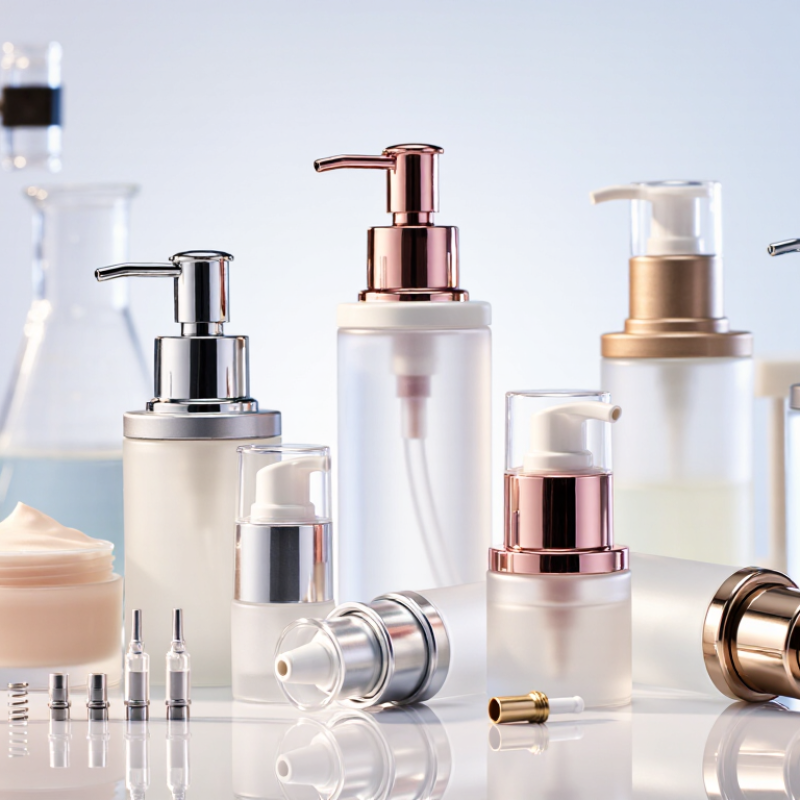
| Lotion pump | Body lotion, hand cream, cleanser, and other pumpable lotions | A spring-driven piston draws product through a dip tube and dispenses it through the actuator. | Often paired with plastic bottles. Pump components may use polypropylene (PP), polyethylene (PE), or other compatible polymers; material choice varies by design. | Check dose consistency, dip-tube fit, closure size, priming, leakage, and compatibility with the formula. |
| Treatment pump | Serums, facial treatments, liquid moisturizers, and targeted-care products | A compact dispensing mechanism releases a measured portion when the actuator is pressed. | Commonly used with small bottles. The actuator and outlet should suit the product’s viscosity and dispensing needs. | Evaluate dose repeatability, clogging risk, user control, and whether the formula remains stable in contact with the selected materials. |
| Airless dispenser | Creams, gels, lotions, and formulas for which limiting contact with outside air is a packaging priority | A piston or flexible pouch moves product toward the outlet as the contents are dispensed, reducing the need for a conventional dip tube. | Available in several bottle and cartridge constructions. “Airless” describes the dispensing system and does not by itself guarantee a sterile or fully oxygen-proof package. | Test evacuation, priming, sealing, formula compatibility, and performance through the intended fill and use cycle. |
| Foam pump | Foaming facial cleansers and hand or body washes formulated for foaming dispensers | The pump mixes liquid with air through a foaming mesh or similar component to produce foam at the outlet. | Designed for suitable, generally low-viscosity formulas. The pump and formula need to be developed or validated together. | Confirm foam quality, mesh performance, formula viscosity, priming behavior, and resistance to blockage. |
| Fine-mist pump | Facial mists, toners, and other sprayable, low-viscosity liquids | A small orifice and internal components atomize liquid into droplets when the actuator is pressed. | Usually paired with bottles suitable for liquid formulations. Spray pattern depends on the pump design and the product’s properties. | Assess spray pattern, droplet consistency, leakage, actuator comfort, and compatibility with the formula. |
| Locking pump | Travel-oriented or everyday skincare bottles where accidental actuation should be reduced | A twist, clip, or other locking feature helps prevent the actuator from dispensing while secured. | Can be incorporated into different pump styles. Locking mechanisms and closure configurations vary by design. | Check lock reliability, ease of use, shipping performance, and whether the locked pump fits the chosen bottle and cap. |