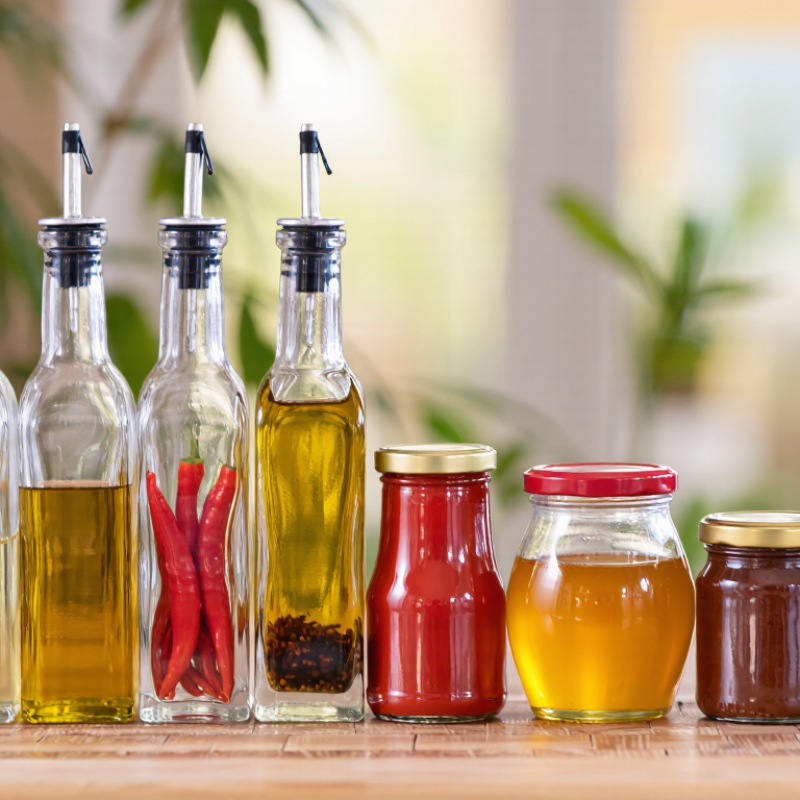
| Glass composition | Many food and beverage containers are made from soda-lime-silica glass, formed from a batch that commonly includes silica, soda ash, and limestone. | Clear glass shows the product; amber and green glass can reduce exposure to some light wavelengths. | Confirm that the glass is suitable for the product, intended storage conditions, and applicable food-contact requirements. |
| Batch preparation and melting | Raw materials are proportioned and mixed, then melted in a furnace. Recycled glass, known as cullet, may also be included in the batch. | Batch composition and cullet use depend on the glass formulation, product requirements, and manufacturing process. | Ask for material and food-contact documentation relevant to the destination market and intended use. |
| Bottle forming | Molten glass is cut into measured portions called gobs. A forming machine shapes each gob in a mold to create the bottle. | Press-and-blow and blow-and-blow are established forming methods; the suitable method depends on the container design and production requirements. | Review samples for shape consistency, finish quality, base stability, and compatibility with filling and capping equipment. |
| Annealing | Newly formed bottles pass through an annealing lehr, where controlled cooling helps reduce internal stresses in the glass. | Cooling conditions are managed as part of the production process and vary with the glassware and line setup. | Request the supplier’s inspection and process-control information, especially for bottles that will face filling or handling stresses. |
| Capacity and dimensions | Bottle capacity, height, body shape, and neck dimensions are established in the product design and checked during production. | Common design choices include straight-sided bodies, rounded shoulders, and different neck or opening sizes. | Specify fill volume, brimful capacity if required, dimensional tolerances, and the available space on the filling line. |
| Neck finish and closure | The neck finish is formed to work with a compatible closure and sealing system. | Options can include screw finishes and other closure-compatible designs; the right choice depends on the cap, liner, and dispensing needs. | Test the bottle with the exact closure and liner. Check fit, sealing performance, and opening or dispensing requirements. |
| Dispensing design | The opening and neck can be designed around the condiment’s flow behavior and the intended way of serving it. | Wide openings can support thicker products or easier filling; restricted openings or inserts can help control pouring when compatible with the product. | Evaluate pour rate, clogging risk, product residue, cleaning needs, and user handling with the actual condiment. |
| Decoration and labeling | Branding and product information may be applied using labels or glass-decoration methods such as screen printing. | Decoration choices affect appearance and may influence minimum order quantities, lead times, and recycling considerations. | Confirm artwork, label dimensions, adhesive suitability, print durability, and required market information before production. |
| Quality inspection | Manufacturers can inspect appearance and key dimensions and use checks suited to the bottle design and production process. | Inspection plans may cover cracks, chips, finish defects, capacity, dimensions, and performance requirements agreed with the buyer. | Agree on acceptance criteria, sampling procedures, defect definitions, and any testing required for the intended filling and distribution conditions. |
| Packaging and shipment | Glass bottles are packed to limit movement and contact damage during storage and transport. | Packaging format depends on bottle shape, shipment method, and handling requirements. | Review the packing method, pallet configuration, protective materials, and shipment inspection process before placing an order. |