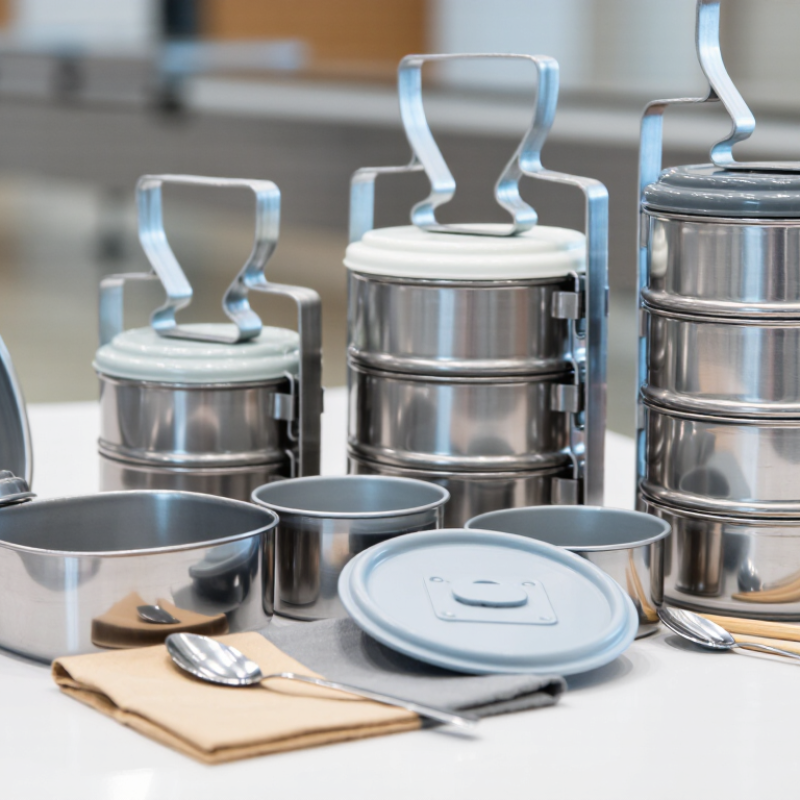
| Typical Product Structure | Single-, double-, and multi-tier containers; common configurations include removable compartments, snap-lock lids, silicone seals, and separate cutlery sections. | Buyers can specify capacity, tier count, leak-resistance requirements, and packing configuration according to the target market. |
| Common Food-Contact Materials | Food-contact stainless steel, polypropylene (PP), silicone sealing components, and glass are commonly used material categories. | Material selection affects durability, weight, temperature resistance, recyclability, and regulatory documentation. |
| Frequently Specified Stainless Steel | Austenitic stainless steels such as 304 are widely used for food-contact components; 316 may be selected where higher corrosion resistance is required. | Request the exact steel grade, material composition, surface finish, and migration or corrosion-test documentation before approval. |
| Typical Manufacturing Processes | Metal deep drawing or stamping, polishing, plastic injection molding, silicone compression molding, assembly, leak testing, and packaging. | The selected process influences tooling cost, dimensional consistency, surface quality, production capacity, and customization options. |
| China Food-Contact Framework | China’s GB 4806 series covers food-contact materials and articles, including general safety requirements, plastics, metal materials, and rubber or silicone-related materials. | For China-market compliance, buyers should identify the applicable GB 4806 standard for every material and component in contact with food. |
| European Union Requirements | EU Regulation (EC) No 1935/2004 establishes general requirements for food-contact materials; plastics are additionally covered by Regulation (EU) No 10/2011. | EU importers should request a Declaration of Compliance, supporting test reports, and full material traceability. |
| United States Requirements | Food-contact substances may fall under applicable U.S. FDA regulations in Title 21 of the Code of Federal Regulations, depending on the material and intended use. | The intended food type, temperature, contact time, and material composition should be reviewed against the relevant FDA provisions. |
| Core Quality-Control Checks | Dimensional inspection, lid-fit verification, leak testing, hinge or latch durability, surface inspection, odor assessment, and food-contact migration testing. | A written inspection plan helps reduce leakage, deformation, sharp-edge, coating, and odor-related claims after shipment. |
| Common Customization Options | Capacity, tier arrangement, compartment layout, colors, surface finish, lid design, packaging, labeling, and non-branded private-label artwork. | Confirm whether customization requires new tooling, minimum order quantities, artwork approval, or additional compliance testing. |
| Packaging Considerations | Typical export packaging includes individual protective packing, inner cartons, master cartons, and moisture- or impact-reduction measures where needed. | Carton dimensions, stacking strength, drop protection, and shipping marks should be confirmed before mass production. |
| Buyer Documentation Checklist | Material specifications, food-contact test reports, Declaration of Compliance where applicable, product drawings, inspection standards, carton details, and batch traceability records. | Complete documentation supports customs clearance, retailer onboarding, product claims, and post-market traceability. |