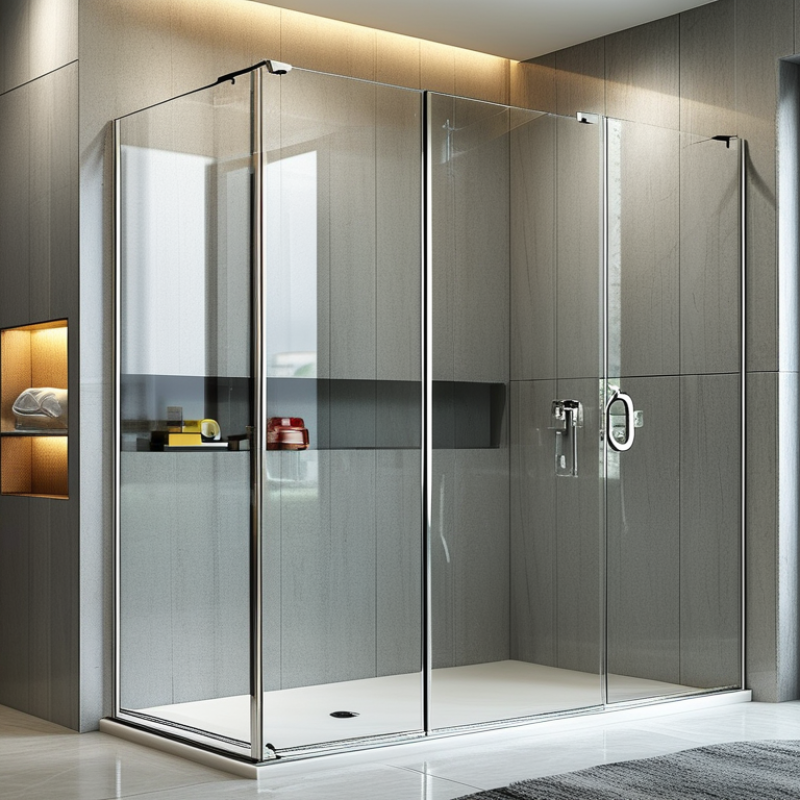
| Product Scope | Confirm whether the supplier produces complete shower enclosures, glass panels, doors, trays, profiles, rollers, hinges, handles, and sealing systems. | Current product catalog, technical drawings, component list, material specifications, and production photographs. | Prefer a supplier with documented control over the major components required for the complete project. |
| Glass Type | Shower enclosures commonly use safety glass, especially thermally toughened or laminated glass. Confirm whether the glass is clear, low-iron, frosted, patterned, tinted, or coated. | Glass specification sheet, processing flow, inspection records, and sample approval document. | The selected glass type should match the destination-market safety rules, appearance requirements, and installation design. |
| Glass Thickness | Common shower-glass thicknesses include 6 mm, 8 mm, and 10 mm. The required thickness depends on panel size, support method, door design, and applicable standards. | Approved drawings showing glass thickness, maximum panel dimensions, hardware compatibility, and allowable tolerances. | Do not select by thickness alone; verify structural suitability and compatibility with hinges, rollers, channels, and seals. |
| Safety-Glass Compliance | For Europe, EN 12150 is commonly used for thermally toughened soda-lime silicate safety glass. For the United States, ANSI Z97.1 and 16 CFR 1201 are commonly referenced for safety glazing. | Reports from an appropriately accredited laboratory, product markings where required, declarations of conformity, and test-sample identification. | Check that the report applies to the actual glass construction, thickness, processing method, and intended market. |
| Tempering Quality | Toughened glass should be heat-treated and processed before tempering, because cutting, drilling, and edge work after tempering can compromise the panel. | Tempering records, heat-treatment parameters, edge-processing specifications, hole-position drawings, and breakage-test records. | Reject suppliers that cannot provide traceable records for the production batch or cannot confirm that all drilling and edge work is completed before tempering. |
| Glass Surface and Edge Finish | Check flatness, edge polishing, corner treatment, hole quality, scratches, chips, stains, inclusions, and coating uniformity. | Quality-control checklist, approved limit samples, dimensional inspection report, and close-up production samples. | Use a signed visual standard with measurable defect limits instead of relying only on general statements such as “premium quality.” |
| Hardware Material | Common hardware materials include stainless steel, aluminum, zinc alloy, brass, and engineered plastics. Confirm the exact grade or alloy for each component. | Material certificates, component drawings, surface-finish specifications, and supplier declarations. | For wet environments, evaluate corrosion resistance, load capacity, finish durability, and compatibility between dissimilar metals. |
| Corrosion Resistance | Salt-spray testing may be used as a comparative test for metal finishes, but test duration and acceptance criteria must be agreed in advance because they are not universal for every shower component. | Test method, exposure duration, laboratory report, finish specification, and evidence from production batches. | Compare suppliers using the same test method and acceptance criteria; do not compare unsupported “hours of salt spray” claims. |
| Dimensional Accuracy | Verify panel width, height, diagonal, hole diameter, hole position, profile length, door clearance, and installation tolerance against approved drawings. | Dimensioned drawings, inspection gauges, first-article inspection report, and final inspection report. | A reliable supplier should define tolerances before production and record actual measurements for critical dimensions. |
| Water-Tightness Design | Water control depends on door overlap, seals, thresholds, drainage slope, panel alignment, and installation conditions rather than glass alone. | Installation drawings, seal profiles, water-test procedure, drainage details, and maintenance instructions. | Require a documented water-test method and clearly defined responsibilities for product defects versus site-installation errors. |
| Factory Capability | Assess glass cutting, edge processing, drilling, tempering, assembly, inspection, packaging, and engineering resources. | Factory audit records, equipment list, process flow chart, production capacity statement, and recent non-confidential inspection records. | Give higher scores to suppliers with controlled in-house processes and transparent subcontracting arrangements. |
| Quality Management | An ISO 9001 certificate can indicate a quality-management system, but it does not by itself prove that a specific shower product meets safety or performance requirements. | Valid certificate, certification scope, internal inspection plan, corrective-action records, and batch traceability procedure. | Verify the certificate with the issuing certification body and evaluate actual inspection practices separately. |
| Sample Approval | The production sample should match the approved specification for glass, finish, dimensions, hardware, seals, logo restrictions, packaging, and accessories. | Signed sample approval sheet, reference sample, approved drawings, and pre-production checklist. | Do not authorize mass production until all critical sample differences are closed in writing. |
| Minimum Order Quantity | MOQ varies by product complexity, glass type, color, hardware finish, packaging method, and customization level. It must be quoted for the exact specification. | Formal quotation stating MOQ by model, surcharge for low-volume orders, sample policy, and tooling charges. | Compare total landed cost rather than unit price alone, including tooling, packaging, inspection, and low-volume charges. |
| Lead Time | Lead time should be separated into sample approval, raw-material preparation, production, inspection, and export packing. Actual timing depends on order size and customization. | Production schedule, capacity confirmation, shipment window, and written delay-notification procedure. | Use a milestone-based schedule and avoid accepting an unqualified single delivery estimate. |
| Packaging and Breakage Control | Packaging should protect glass edges, corners, surfaces, and hardware during handling and ocean or road transport. Each crate should be suitable for the agreed shipment method. | Packaging specification, crate photographs, loading plan, drop or handling-test records where applicable, and spare-parts policy. | Request export-grade packaging and define responsibility, evidence requirements, and claim deadlines for transit damage. |
| Export Documentation | Typical documents may include commercial invoice, packing list, bill of lading, certificate of origin where required, test reports, and product-specific declarations. | Sample document set, HS-code proposal for buyer review, packing details, and destination-market compliance documents. | Confirm document requirements before shipment and ensure product descriptions and quantities are consistent across documents. |
| Traceability | Traceability should link the finished unit to the order, glass batch, hardware batch, inspection records, and packaging labels. | Batch-number format, production labels, inspection records, and retention period for quality documents. | Select suppliers that can identify affected batches quickly if a defect or breakage issue occurs. |
| Warranty and After-Sales Service | Warranty terms should distinguish manufacturing defects, finish failure, hardware wear, glass breakage, installation damage, and misuse. | Written warranty, claim procedure, response-time commitment, replacement policy, spare-parts list, and installation guidance. | Prefer clear, written remedies and readily available replacement seals, rollers, hinges, and fasteners. |
| Commercial Reliability | Evaluate quotation completeness, payment terms, contract consistency, change-control procedure, communication speed, and willingness to provide verifiable evidence. | Business registration information, signed quotation, sales contract, bank-account consistency, references, and third-party audit results where available. | Use independent verification for high-value orders and avoid payments to accounts that do not match the contracted legal entity. |
| Recommended Scoring Model | Score each supplier from 1 to 5 for compliance, quality, factory capability, delivery, cost, documentation, and after-sales service. | Completed supplier-evaluation worksheet with evidence attached to every score. | Use higher weighting for safety compliance, dimensional quality, and delivery reliability than for price alone. |