| Ink Selection | Water-based textile ink | Air-drying tendency; heat cure commonly around 150–170°C | Soaks partly into the fibers and can produce a soft hand feel. | Prevent ink from drying in the screen; maintain adequate humidity and clean the screen promptly. |
| Ink Selection | Plastisol textile ink | Common cure range: approximately 150–170°C, depending on the ink system | Forms a flexible film on top of the fabric and provides strong opacity. | Measure the ink-film temperature, not only the dryer air temperature, to confirm complete curing. |
| Ink Selection | Discharge ink | Typically heat activated; often processed around 150–170°C | Lightens or replaces the fabric dye while depositing color into the fibers. | Test each fabric because dye chemistry, moisture, and curing conditions affect discharge performance. |
| Screen Preparation | Mesh count | Approximately 32–55 threads/cm for many standard textile prints | Controls ink flow, detail reproduction, and the amount of ink deposited. | Use lower mesh counts for heavier ink deposits and higher mesh counts for finer detail. |
| Screen Preparation | Stencil thickness | Commonly about 10–25 micrometres of emulsion thickness above the mesh | A thicker stencil generally deposits more ink and increases print opacity. | Keep coating thickness consistent across the image area to avoid uneven coverage. |
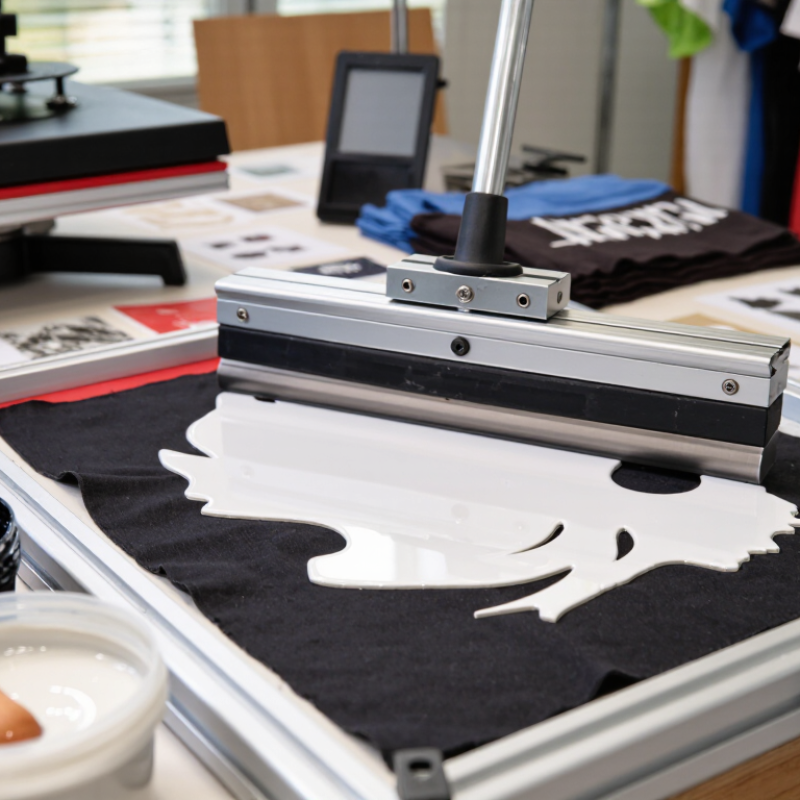
| Squeegee Setup | Squeegee hardness | 70–80 Shore A | Provides a balanced combination of ink control, edge definition, and fabric conformity. | Use softer rubber for uneven or textured fabric and harder rubber for fine detail or sharper deposits. |
| Squeegee Setup | Squeegee angle | 15–25° relative to the screen surface | A lower angle can increase ink deposit; a higher angle can reduce deposit and improve control. | Keep the angle consistent during the stroke and adjust only when deposit or detail requires it. |
| Squeegee Setup | Squeegee pressure | The minimum pressure needed to clear the stencil | Excess pressure can force ink beyond the image edge and reduce print sharpness. | Increase pressure gradually until the print clears without leaving unprinted stencil areas. |
| Squeegee Setup | Stroke speed | Often approximately 100–300 mm/s, depending on equipment and ink viscosity | Affects ink release, edge definition, and the consistency of the printed film. | Use a slower stroke for viscous or highly opaque inks and a faster stroke when excessive deposit occurs. |
| Screen Contact | Off-contact distance | Commonly about 2–5 mm for textile screen printing | Allows the screen to snap away from the fabric after the squeegee passes. | Set the smallest distance that prevents screen sticking while maintaining clean release. |
| Printing | Flood stroke | Light pressure; ink spread across the image area | Places ink over the open stencil openings before the printing stroke. | Avoid forcing ink through the mesh during flooding unless the process specifically requires it. |
| Printing | Print passes | Usually one print stroke; two or more for higher opacity | Additional passes can increase coverage but may soften fine details. | Use a consistent stroke direction, pressure, and speed for every garment in the batch. |
| Multi-Layer Printing | Flash drying between layers | Surface-dry condition, commonly around 90–120°C for a short cycle | Allows another ink layer to be printed without excessive mixing or lifting. | Avoid over-flashing, which can reduce adhesion between layers or partially cure the lower layer. |
| Final Curing | Cure verification | Confirm the ink film reaches the supplier-specified cure temperature and dwell time | Ensures adequate wash durability, flexibility, and adhesion to the textile. | Verify with temperature-sensitive labels, a temperature probe, and wash testing where appropriate. |
| Quality Control | Print appearance | Even coverage, sharp edges, consistent color, and no pinholes | Indicates that mesh, stencil, ink viscosity, and squeegee settings are working together. | Inspect the first approved print and compare subsequent garments against the approved sample. |