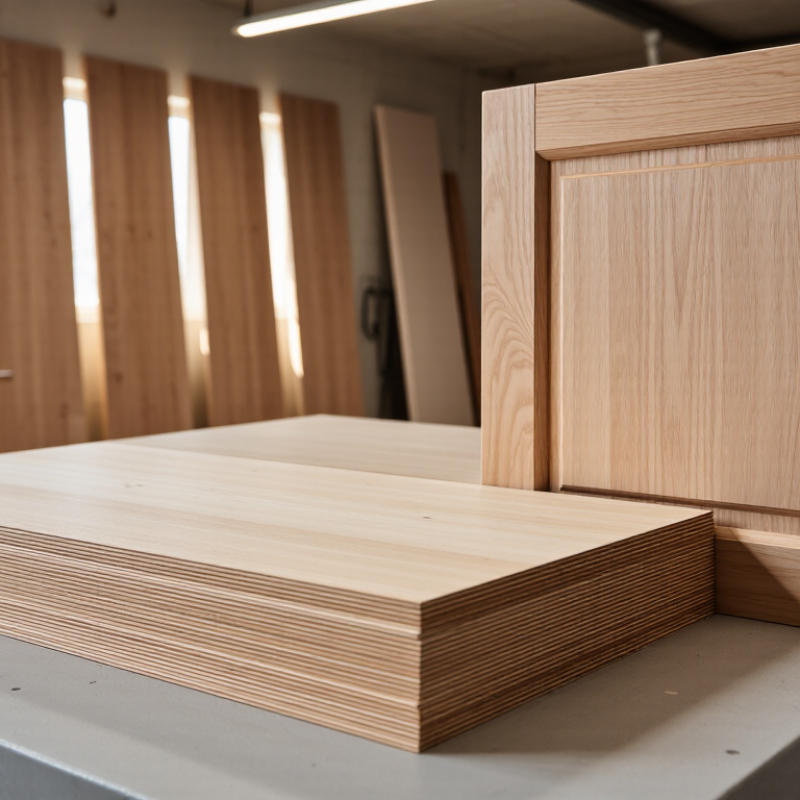
| Premium Hardwood Plywood | High-quality hardwood face veneers over a balanced veneer core, with relatively consistent thickness and fewer visible defects. | 6–25 mm | Cabinet doors, furniture, wall panels, shelving, built-ins, and decorative interior joinery. | Attractive appearance, good screw-holding capacity, reliable machining, and a strong surface for staining or clear finishing. | Standard interior grades are not automatically suitable for prolonged moisture or outdoor exposure. |
| Baltic Birch-Style Plywood | Multiple relatively thin birch veneer layers, often with a consistent all-wood core and exposed edge laminations. | 3–24 mm | Drawers, cabinets, stools, desks, shelving, toys, laser-cut parts, and precision furniture components. | Uniform structure, clean edges, good stiffness, strong fastener retention, and attractive layered edges. | The appearance and performance can vary by grading system; edges may require sealing for humid environments. |
| Marine Plywood | Manufactured with durable veneer layers, minimal core gaps, and waterproof adhesive. Some products are certified to marine plywood standards such as BS 1088. | 6–25 mm | Boat components, exterior panels, wet-area construction, outdoor furniture, docks, and exposed joinery when properly sealed. | Improved resistance to delamination, moisture, and core voids compared with ordinary interior plywood. | It is not rot-proof or maintenance-free; all faces, edges, holes, and joints require appropriate protection. |
| Exterior-Grade Structural Plywood | Structural veneer panels bonded with exterior-rated adhesive and graded for defined strength, stiffness, and surface quality requirements. | 9–32 mm | Roof decking, wall sheathing, subfloors, roof overhangs, temporary structures, and load-bearing timber assemblies. | Good panel strength, dimensional stability, and resistance to short-term weather exposure when installed correctly. | Structural grade does not necessarily mean a decorative face; prolonged exposure still requires cladding, paint, or a suitable coating. |
| Flexible Plywood | Very thin veneers arranged to allow bending along one direction or, in some constructions, in two directions. | 3–8 mm | Curved furniture, rounded counters, display forms, architectural features, boat interiors, and model-making. | Can form smooth curves with fewer joints than standard plywood and reduces the need for multiple narrow strips. | Usually needs a supporting frame or laminated layers and is not intended for heavy structural loading by itself. |
| Fire-Retardant Plywood | Plywood treated or manufactured to achieve a specified fire-performance classification under a recognized building or test standard. | 9–25 mm | Public interiors, wall and ceiling panels, exhibition spaces, transport interiors, and areas with documented fire-performance requirements. | Can help meet specified flame-spread, smoke, or fire-performance requirements when the complete assembly is approved. | Fire performance is product- and assembly-specific; cutting, sanding, coating, or installation may affect compliance. |
| Film-Faced Plywood | Structural plywood covered with a resin-impregnated film that creates a smoother, more moisture-resistant working surface. | 12–21 mm | Concrete formwork, reusable casting panels, truck floors, industrial platforms, and high-wear temporary surfaces. | Smooth release surface, improved abrasion resistance, easier cleaning, and better resistance to occasional moisture. | Damaged film and exposed edges can permit water ingress; it is generally unsuitable where a natural decorative face is required. |
| Aircraft-Grade Plywood | Thin, lightweight, closely controlled veneer construction made for specialized applications requiring a high strength-to-weight ratio. | 1–6 mm | Scale models, lightweight instrument panels, specialty furniture details, musical instruments, and small engineered components. | Light weight, thin uniform layers, precise machining, and high stiffness relative to its thickness. | More expensive and less widely available; it must not be used in certified aircraft structures without the required engineering approval. |