Dry indoor areas
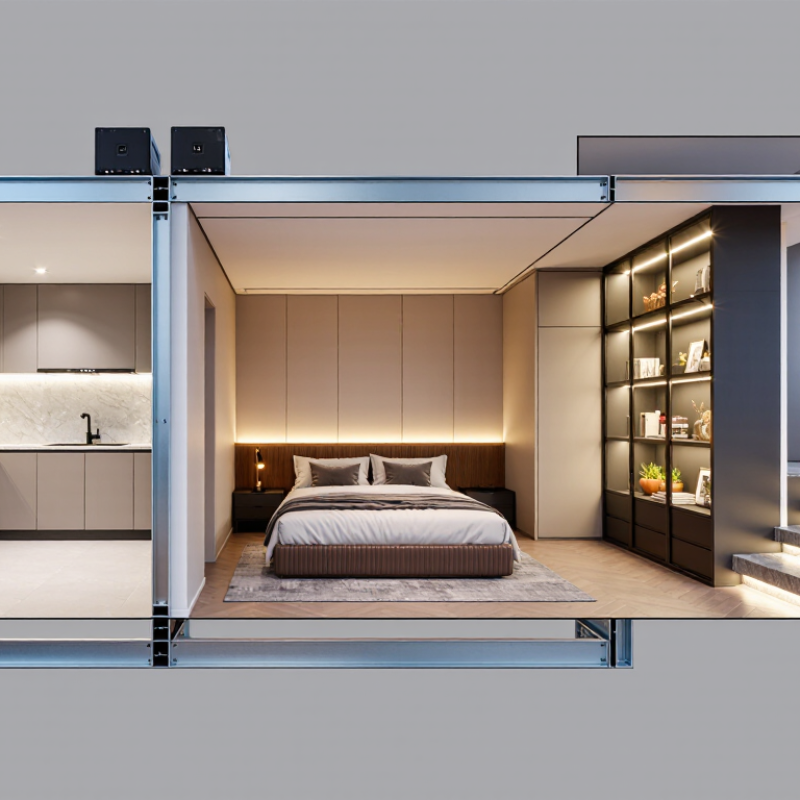
Bedrooms, offices, shelves | IP20 or equivalent open-board construction; no protection against water. | Use an aluminium profile for continuous operation or strips above approximately 9.6 W/m. | 12 V or 24 V DC; 4.8–14.4 W/m is common; select the power supply with at least 20% spare capacity. | Compatible with constant-voltage dimmers, PWM controllers, timers, and smart relays rated for the same voltage and load. | Keep away from condensation. Mount on a clean, dry surface and provide ventilation around the power supply. | Prioritise colour quality, brightness, cut length, and profile size rather than water resistance. |
Kitchens and bathrooms
Under cabinets, mirrors, vanity areas | IP44–IP65, depending on exposure. IP65 protects against water jets when correctly sealed. | Use an aluminium channel with a diffuser to spread heat and protect the strip from splashes. | 24 V DC is preferred for longer runs because it reduces voltage drop compared with 12 V systems. | Use a moisture-suitable controller; keep mains-powered control equipment outside wet zones unless specifically approved. | Seal end caps and cable entries. Do not rely on the strip’s IP rating if cut ends are left unsealed. | Check the actual wet-zone location, cut-end sealing method, and local electrical requirements. |
Outdoor covered areas
Porches, eaves, covered signage | IP65 for water jets; IP67 for temporary immersion protection when the complete assembly is properly sealed. | Use a weather-resistant aluminium profile. Silicone-coated strips may retain more heat than bare-board versions. | 12 V or 24 V DC; calculate voltage drop over the full cable and strip length before installation. | Select outdoor-rated connectors, controllers, and power supplies with suitable operating-temperature ranges. | Protect power supplies from direct rain and provide drip loops in cables. Avoid placing sealed strips in trapped heat. | Confirm UV resistance, temperature range, connector sealing, and the rating of the complete system. |
Gardens and exposed locations
Pathways, façades, landscape accents | IP67 or IP68 may be appropriate, but IP ratings apply only under the test conditions stated for the product. | Use low-to-moderate power density or a metal profile rated for outdoor use; prevent water from collecting around joints. | 24 V DC is generally easier to manage for long outdoor runs; use appropriately sized low-voltage cable. | Controllers must be protected in a suitable enclosure and rated for the strip’s current, voltage, and channel count. | Use sealed connectors and junction boxes. Do not cut or bend the strip beyond the manufacturer’s specified limits. | Verify UV stability, impact resistance, drainage, minimum bend radius, and replacement access. |
Long architectural runs
Coves, corridors, commercial interiors | IP20 for dry concealed spaces; choose a higher rating only when moisture protection is required. | Install continuously in an aluminium profile. Use parallel power injection when the run exceeds the strip’s recommended feed length. | 24 V DC; select the supply from total watts: strip length × watts per metre, then add at least 20% capacity. | For dimming, use a PWM controller or constant-voltage dimmer that matches the control protocol and total current. | Plan access points, cable routes, voltage-drop limits, and thermal expansion before fixing the profile. | Check uniformity, maximum continuous length, feed-point spacing, dimming frequency, and driver capacity. |
Colour-changing installations
Mood lighting, events, media rooms | IP20 indoors; IP65 or higher for areas exposed to moisture, with sealed RGB/RGBW connectors. | Use an aluminium profile, especially for high-density RGBW strips, because multiple colour channels can increase heat output. | 12 V or 24 V DC; RGB typically uses three channels, while RGBW uses four channels and needs a compatible controller. | Match analogue RGB/RGBW, addressable-data, or DALI/DMX control systems correctly; these are not interchangeable. | Confirm wiring order, controller channel capacity, data direction for addressable strips, and signal-loss limits. | Identify the strip type first: single-colour, tunable white, RGB, RGBW, or individually addressable. |
High-brightness task lighting
Worktops, retail displays, workshops | IP20 in dry areas; use IP44–IP65 if cleaning spray or splashing is expected. | An aluminium profile is essential for sustained high output. Avoid mounting directly to wood, plastic, or painted surfaces without heat spreading. | Commonly 24 V DC at 14.4–28.8 W/m; verify the power supply’s continuous current rating and ventilation. | Use a dimmer rated above the calculated load; choose a flicker-controlled driver for camera-facing or precision work. | Use a diffuser to reduce glare and maintain consistent spacing from the illuminated surface. | Compare lumens per metre, colour rendering, glare control, thermal path, and expected operating hours. |