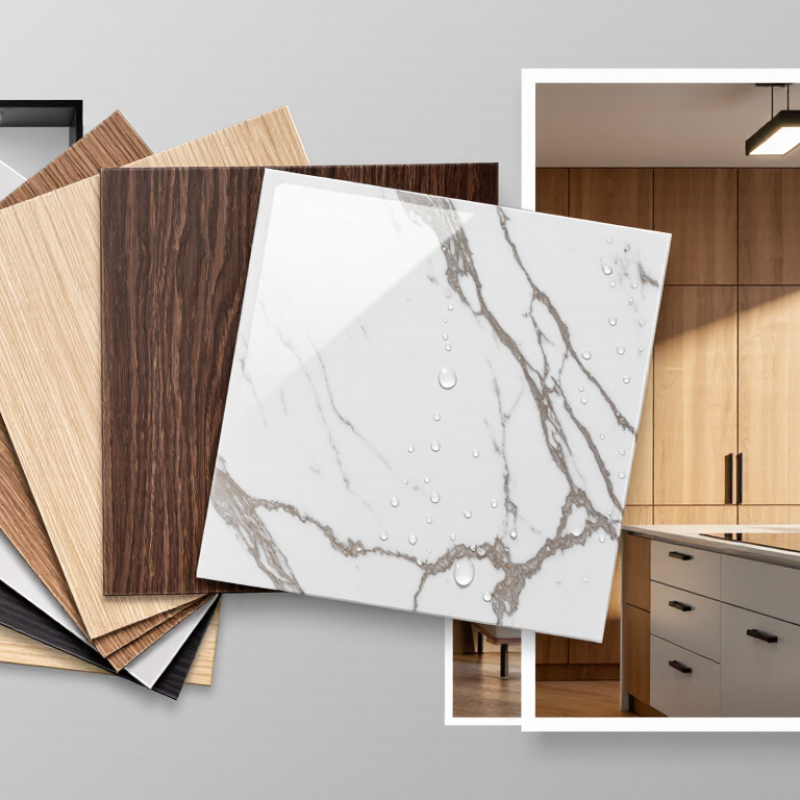
| Melamine-faced particleboard | Commonly about 1,220 × 2,440 mm; often 16–18 mm thick | Hard, wipe-clean surface; edges and core can swell if exposed to water for long periods. | Choose boards that meet applicable formaldehyde-emission rules. Cut edges may need sealing; control dust when cutting. | Suitable for wardrobes, shelving, and dry-area cabinetry. Use compatible edge banding and fixings designed for particleboard. |
| Decorative MDF | Commonly about 1,220 × 2,440 mm; available in multiple thicknesses, often 6–25 mm | Smooth, uniform surface for paint or veneer; standard MDF is not intended for prolonged damp conditions. | Use compliant low-emission material and dust extraction or a suitable respirator when machining. Seal exposed faces and edges as needed. | Works well for painted panels, wall details, and furniture components. Use moisture-resistant grades only where their specifications allow. |
| Decorative plywood | Commonly about 1,220 × 2,440 mm; often 9–18 mm thick | Cross-laminated layers provide useful strength and stability; performance depends on grade, veneer, and adhesive. | Check the panel’s emissions and intended-use rating. Wear eye protection and manage dust during cutting. | Suitable for furniture, cabinets, and wall panels. Select an appropriate grade for the expected moisture exposure and finish. |
| High-pressure laminate (HPL) sheet | Sheet sizes vary; a common format is about 1,300 × 3,050 mm; often 0.7–1.2 mm thick | Resistant to everyday abrasion and staining; a thin sheet is not a structural panel by itself. | Follow adhesive and cutting-product instructions. Avoid overheating during fabrication and provide suitable ventilation. | Typically bonded to a stable substrate such as plywood or MDF. Confirm that the adhesive and substrate suit the project conditions. |
| Cement-bonded particleboard | Common formats are around 1,200 × 2,400 mm; thicknesses often range from 8–40 mm | Generally more tolerant of moisture and impact than standard particleboard; heavy and still requires correct detailing. | Cutting creates dust; use appropriate respiratory and eye protection. Check the product documentation for fire and exposure ratings. | Can suit demanding interior or exterior applications when the board is rated for them. Use compatible fasteners, supports, and finishes. |
| Solid wood panel | Panel sizes vary; commonly made from joined strips, with thicknesses around 18–30 mm | Can be repaired and refinished; wood expands and contracts with changes in humidity. | Check coatings and finishes for suitability, and use dust control when sanding or machining. | Suitable for furniture, doors, and visible surfaces. Allow for wood movement in panel sizing, joints, and installation details. |