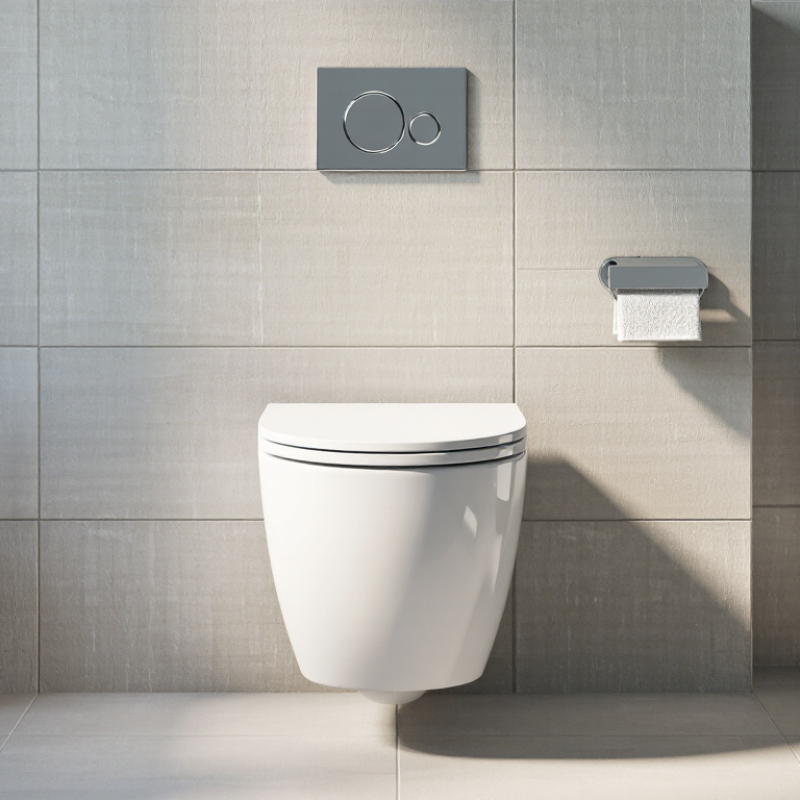
| Product definition | A wall mounted toilet bowl is suspended from a concealed wall carrier rather than fixed directly to the finished floor. | The floor remains open, making cleaning easier and creating a lighter visual appearance. | Confirm whether the quotation includes only the ceramic bowl or also the carrier frame, cistern, flush plate, seat, and installation hardware. |
| Overall projection | Approximately 490–560 mm from the finished wall to the front of the bowl; compact models may be shorter. | Projection affects bathroom circulation, door clearance, and compliance with accessibility requirements. | Check the complete installed projection, including the seat and flush plate, not only the ceramic dimensions. |
| Bowl width | Commonly about 350–380 mm, although comfort and compact designs vary. | Width influences user comfort, side clearance, and compatibility with the carrier frame. | Compare the bowl width with the available wall space and the required side-clearance rules in the destination market. |
| Seat height | A standard installed seat height is often around 400–450 mm from the finished floor; accessible installations may be higher. | Height affects comfort, ease of transfer, and accessibility. | Measure from the finished floor to the top of the seat, and confirm that the carrier allows the required adjustment range. |
| Wall fixing centres | Common carrier fixing centres include approximately 180 mm and 230 mm, depending on the system. | The fixing pattern must match the bowl and the concealed carrier. | Request a technical drawing showing bolt spacing, bolt diameter, mounting height, and allowable adjustment. |
| Waste outlet connection | Common nominal outlet sizes include approximately 90–110 mm, with adapters used in some installations. | The outlet must align with the building drainage pipe and the carrier connection. | Verify the actual pipe diameter, connector type, insertion depth, and local plumbing requirements before ordering. |
| Flush volume | Dual-flush configurations commonly use approximately 3 L for reduced flush and 6 L for full flush; other regional settings are available. | Flush volume affects water consumption, performance, and regulatory compliance. | Check the certified flush settings, required operating pressure, and destination-country water-efficiency rules. |
| Water pressure requirement | Concealed cistern systems commonly require a suitable mains supply and may specify a minimum inlet pressure; the exact value is system-specific. | Insufficient pressure can cause slow filling or unreliable flushing. | Obtain the manufacturer’s minimum and maximum pressure data and compare it with the project’s water supply. |
| Structural load support | The carrier frame, wall structure, fixings, and bowl work together to support the user; some tested carrier systems are rated around 400 kg, but ratings vary. | A wall mounted bowl transfers load into the carrier and building structure rather than the floor. | Request a load-test report or conformity documentation and confirm the wall type, anchoring method, and installation conditions. |
| Ceramic material | Vitreous china or sanitary ceramic is commonly used, with a glazed surface for hygiene and easier cleaning. | Material quality, glaze uniformity, and firing consistency affect durability and appearance. | Inspect glaze coverage, dimensional tolerances, water absorption data, edge quality, and packaging protection. |
| Rim design | Available designs include conventional rimmed bowls and rimless or open-rim flushing designs. | Rimless designs can improve access for cleaning, while flushing performance depends on hydraulic design. | Review independent flushing-test results, splash control, bowl wash coverage, and cleaning access. |
| Seat compatibility | Seat options may include standard, soft-close, quick-release, or accessible designs. | Seat hinge spacing, shape, and load capacity must correspond with the bowl. | Confirm seat dimensions, hinge centres, replacement availability, and whether the seat is included. |
| Concealed cistern access | Most systems provide service access through the flush plate opening. | Accessible internal components simplify maintenance without removing the finished wall. | Check access-panel size, replacement-part availability, valve compatibility, and service instructions. |
| Installation wall type | Installation may use a framed carrier in a stud wall, a floor-supported carrier, or a masonry-compatible system. | The wall construction determines anchoring, finished depth, and structural stability. | Confirm compatibility with concrete, masonry, metal studs, or timber framing before selecting the carrier. |
| Regulatory documentation | Documentation may include dimensional drawings, installation instructions, plumbing approvals, load testing, and water-efficiency test reports. | Requirements differ between countries and construction projects. | Request current certificates and verify that they are accepted by the destination market, project consultant, or local authority. |