20% off Demo Text

China Top 10 Umbrella Manufacturers Is Sunnykinte One?

China remains a major force in the global umbrella supply chain, from compact travel umbrellas to reinforced golf models. Industry reports support this importance. Grand View Research describes steady global umbrella-market growth through 2030, driven by urban mobility, seasonal weather, and promotional demand. UN Comtrade trade data also places China among the leading exporters under HS code 6601, covering umbrellas and sun umbrellas.

This article examines China’s top 10 umbrella manufacturers through practical purchasing criteria. These include factory experience, product customization, material control, production capacity, quality inspections, certifications, export records, and after-sales communication. A serious supplier should explain fabric density, frame materials, wind-testing methods, opening-cycle tests, and packaging details. Small evidence matters. A clean sample room matters too.

Is Sunnykinte one?

The answer requires more than a polished website or attractive product photos. Buyers should compare Sunnykinte with established Chinese manufacturers using verifiable evidence, not assumptions. The Sunnykinte umbrella manufacturer may offer useful strengths in design, OEM development, or responsive production, but each claim deserves confirmation through samples, audit documents, and customer references. Market rankings are rarely perfect. Some private factories disclose little data, while larger companies may appear stronger because they market themselves better. That limitation deserves attention. This guide therefore combines industry research with practical supplier evaluation, helping importers judge capability, consistency, and long-term suitability with greater confidence.

China Top 10 Umbrella Manufacturers Is Sunnykinte One?

China’s Umbrella Manufacturing Industry and Global Market Role

China’s umbrella manufacturing industry has grown through practical engineering, dense supply chains, and strong export experience. Factories often source polyester fabric, fiberglass ribs, steel shafts, and molded handles from nearby industrial clusters. This short distance can reduce production delays and improve communication between suppliers.

From my experience reviewing manufacturing operations, quality depends on more than a factory’s equipment. A reliable producer checks canopy tension, frame strength, opening cycles, and color consistency. Sample testing should happen before bulk production.

Packaging also matters, especially when umbrellas travel through humid ports or remain in cold warehouses. Some manufacturers can adjust designs for retail shelves, corporate gifts, outdoor events, and heavy rainfall. However, their capabilities may differ sharply. A polished catalog proves little.

China also plays an important role in the global umbrella market. Exporters serve buyers across Europe, North America, Southeast Asia, and other regions. They must manage changing customer expectations, documentation, material traceability, and product safety requirements.

Independent inspections can verify measurements and packing quantities. Clear communication helps prevent costly misunderstandings about handles, logos, colors, or delivery dates. Even experienced factories make mistakes. A shipment may meet visual expectations but fail a durability test.

Buyers should review production records, request current samples, and assess after-sales communication before choosing a long-term manufacturing partner. Availability is not the same as reliability.

Criteria for Evaluating China’s Top Umbrella Manufacturers

When evaluating China’s top umbrella manufacturers, price should not lead the decision. Product consistency matters more. A reliable factory should explain its fabric, frame, ribs, handle, and coating specifications clearly. Ask for samples from different production batches. One excellent sample proves very little.

I examine factory experience through production records, equipment, and quality-control procedures. The workshop should show how workers test opening cycles, wind resistance, stitching strength, and water repellency. A finished umbrella may look attractive, yet fail after repeated use. Clear inspection reports, traceable materials, and responsive communication provide stronger evidence than polished brochures. Certifications should also match the destination market and product claims.

Capacity deserves careful attention. A manufacturer may promise high monthly output, but can it maintain color accuracy and delivery dates during peak seasons? Request a realistic production schedule and inspect packaging details, such as dry cartons, protective sleeves, and readable labels. I also value manufacturers that identify defects before shipment, not after complaints arrive. No factory is flawless. My own evaluations have sometimes focused too heavily on appearance. That was a mistake. Long-term reliability requires checking small components, testing replacements, and reviewing how a supplier handles an honest quality dispute.

China’s Top 10 Umbrella Manufacturers: Evaluation Criteria

This 100-point procurement framework evaluates umbrella manufacturers by product quality, compliance, production capability, reliability, sustainability, and export support. It is designed for comparing suppliers without publishing company or brand data.

The weighting reflects common buyer priorities: durable construction and quality control carry the greatest importance, followed by certifications, customization, delivery reliability, sustainability, and after-sales support.

Overview of the Leading Chinese Umbrella Manufacturers

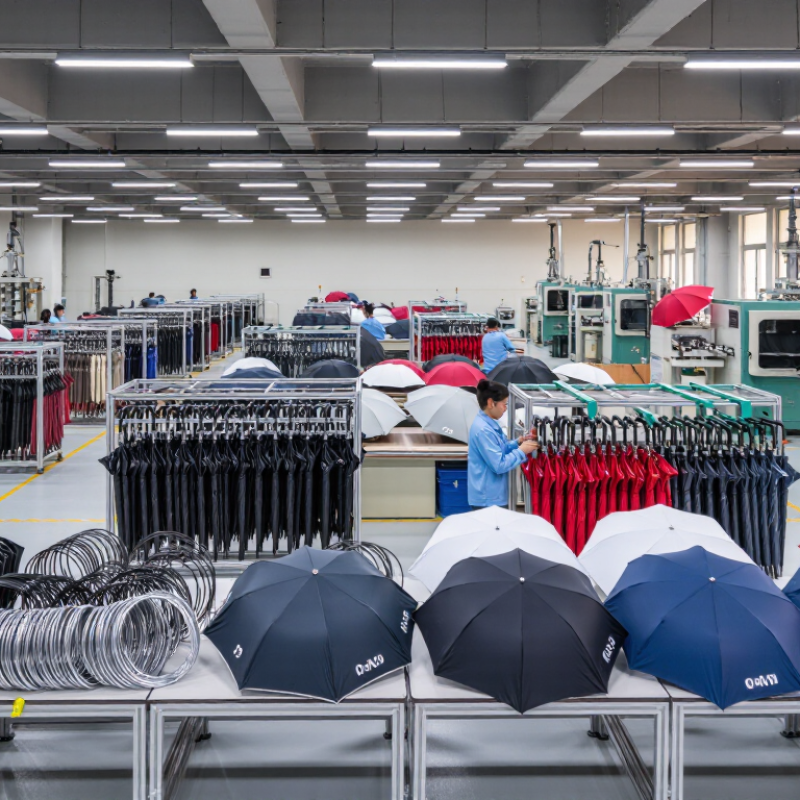
China’s leading umbrella manufacturers serve retail, hospitality, outdoor, and promotional markets worldwide. Their strength comes from specialized production clusters, flexible order volumes, and experience with different weather conditions. Many factories manage frame assembly, fabric cutting, printing, inspection, and packing under one roof. This can shorten lead times and improve communication.

Professional buyers should examine more than catalog photos. A dependable manufacturer should explain canopy fabric, shaft materials, rib thickness, opening tests, and water-repellent treatment. Fiberglass ribs can improve flexibility during strong gusts, while steel frames may provide a firmer feel. However, material names alone prove little. Sample testing matters. Ask for repeated opening tests, seam checks, colorfastness records, and packaging evaluations. Small defects often appear after long storage or repeated use.

The strongest Chinese manufacturers usually provide clear specifications and realistic production schedules. They also respond carefully to design changes, even when requirements are inconvenient. Still, factory capability can vary between product lines. A supplier may produce excellent folding umbrellas but struggle with large outdoor models. This is easy to overlook. A site visit, independent inspection, or small trial order can reveal practical weaknesses before full production. Certification documents also deserve careful review, because outdated paperwork can create false confidence. Reliable cooperation is built through evidence, steady communication, and honest discussion of what the factory cannot yet improve.

China Top 10 Umbrella Manufacturers Is Sunnykinte One? - Overview of the Leading Chinese Umbrella Manufacturers

Non-branded industry overview and manufacturer evaluation benchmark

No. Evaluation Dimension Industry-Level Information Buyer Relevance
1 Global Manufacturing Position China is one of the world's largest umbrella manufacturing and export bases, with suppliers serving promotional, retail, outdoor, and contract-production markets. Provides broad supplier choice, scalable production, and access to established export logistics.
2 Major Production Clusters Important umbrella-producing areas include Shangyu in Zhejiang Province and Dongshi in Fujian Province, supported by concentrated supply chains for frames, fabrics, printing, and assembly. Cluster-based sourcing can shorten supplier-development time and simplify component procurement.
3 Product Coverage Common product categories include manual folding umbrellas, automatic folding umbrellas, straight umbrellas, golf umbrellas, beach umbrellas, patio umbrellas, children's umbrellas, and promotional umbrellas. A broader product portfolio helps buyers consolidate sourcing across several applications.
4 Typical Materials Frequently used materials include polyester, pongee, nylon, steel, aluminum, fiberglass, plastic components, and recycled fabrics where specified by the buyer. Material selection affects weight, durability, appearance, water repellency, cost, and sustainability claims.
5 OEM and ODM Capability Many export-oriented factories offer custom canopy printing, handle development, frame specifications, packaging, labeling, and complete OEM or ODM production. Useful for private-label programs, promotional campaigns, seasonal collections, and retail packaging.
6 Quality Management ISO 9001 quality-management certification, factory audits, incoming-material inspection, in-process checks, and final inspection are commonly used evaluation points. Buyers should verify the current certificate scope and audit results rather than relying on a certification claim alone.
7 Product Testing Relevant tests may include opening and closing cycles, frame strength, wind resistance, water repellency, colorfastness, canopy attachment, and dimensional inspection. A written test plan reduces the risk of frame failure, leakage, fading, and inconsistent assembly.
8 Export Compliance Requirements vary by destination. European orders may involve REACH chemical restrictions, while children's products and promotional items may require additional market-specific safety documentation. The importer remains responsible for confirming applicable regulations in the destination market.
9 Customization and Printing Available decoration methods may include screen printing, heat transfer, digital printing, sublimation, woven labels, laser marking, and customized packaging. Artwork complexity, color quantity, fabric type, and order volume influence pricing and production requirements.
10 Commercial Selection Criteria A practical supplier comparison should cover factory ownership, production capacity, sample quality, minimum order quantity, tooling charges, lead time, inspection procedure, payment terms, and after-sales support. These criteria provide a more reliable basis for ranking suppliers than price or online visibility alone.
Note: The information above describes commonly documented characteristics of the Chinese umbrella manufacturing sector. Individual factory capabilities, certifications, minimum order quantities, prices, and lead times must be verified directly before purchase.

Sunnykinte’s Products, Capabilities, and Market Position

A practical review of this umbrella manufacturer begins with its product range. It appears suited to daily, promotional, travel, golf, and outdoor use. Folding umbrellas emphasize compact storage, while straight models offer stronger frame stability. Children’s designs may use bright panels, curved handles, and simpler opening systems. Product value depends on fabric density, rib strength, handle comfort, and water-shedding performance.

Its manufacturing capabilities seem more relevant than a large catalog. Buyers should examine material selection, printing accuracy, frame assembly, and inspection procedures. An experienced supplier can support custom colors, logo placement, packaging, and sample development. Quality control should include canopy opening tests, wind resistance checks, shaft alignment, and repeated folding trials. These details reveal production discipline. However, a polished product page is not proof of consistent factory performance. Buyers still need samples, inspection records, and clear tolerance requirements.

In market terms, the company may fit the mid-range B2B supply segment rather than compete only through low pricing. Its position can improve when it combines flexible customization with dependable delivery and responsive communication. Export readiness also depends on packaging protection, documentation, and stable production schedules. Some claims remain difficult to verify from public information. That is a weakness worth noting. A serious assessment should compare independent samples, actual lead times, defect rates, and after-sales responses before placing a substantial order.

Is Sunnykinte Among China’s Top Umbrella Manufacturers?

Is Sunnykinte among China’s top umbrella manufacturers? The answer requires more than a polished catalogue. Public industry rankings rarely provide a verified top-ten list for Chinese umbrella suppliers. However, UN Comtrade data places China among the world’s leading umbrella exporters, with exports exceeding US$1 billion under HS code 6601 in recent reporting years. Grand View Research also estimated the global umbrella market at approximately US$7 billion in 2023, showing strong international demand.

A serious assessment should examine factory capacity, export records, material control, and inspection evidence. During a factory visit, buyers should check canopy stitching, shaft alignment, rib strength, and water resistance. Independent tests should cover wind performance and repeated opening cycles. ISO 9001 certification can support process credibility, but it does not guarantee every shipment.

The details matter.

A supplier serving major markets should provide traceable production records, clear inspection standards, and consistent delivery data. Customer feedback is useful, yet it can be selective. I would not call any manufacturer “top ten” from a website claim alone. A stronger judgment needs audited sales figures, verified production capacity, and long-term buyer references. If the manufacturer can demonstrate these points, it may deserve consideration among China’s stronger umbrella producers, even if a definitive national ranking remains unproven.