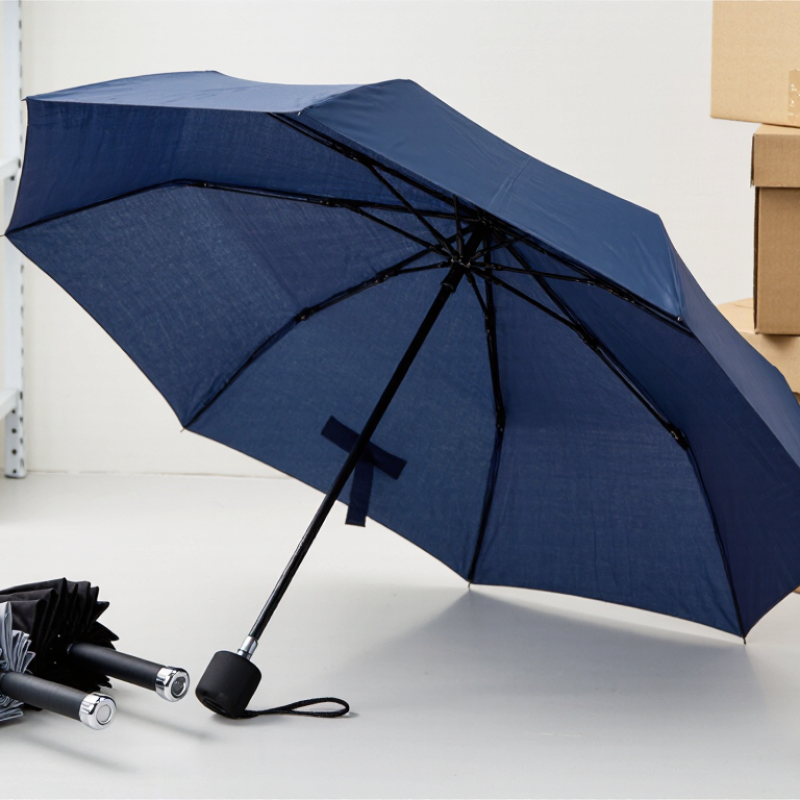
| Closed Length | Approximately 20–30 cm for a standard compact manual or automatic umbrella. | Whether the folded size fits retail packaging, handbags, backpacks, and travel luggage. | Measure a production sample from handle end to tip with the umbrella fully closed. | Compact Format |
| Open Canopy Diameter | Approximately 90–105 cm for a personal-use compact umbrella. | Coverage relative to the folded size and intended end-user segment. | Measure the straight-line canopy span from edge to edge after full opening. | Personal Coverage |
| Product Weight | Approximately 250–400 g for a compact umbrella with a metal or mixed-material frame. | Portability, shipping weight, handle comfort, and suitability for promotional or travel use. | Weigh finished goods with sleeve, strap, and standard accessories included. | Travel-Friendly |
| Frame and Rib Structure | Common compact designs use 6–8 ribs; fiberglass and steel are widely used frame materials. | Flexibility, corrosion resistance, joint strength, and recovery after wind deformation. | Review material declarations and perform repeated opening, closing, and inversion tests. | Durability Check |
| Water Repellency | Rainwear fabric should show effective water beading with minimal visible wetting after testing. | Whether the canopy maintains repellency after laundering, abrasion, and repeated use. | Use AATCC 22 spray test or an equivalent recognized textile water-repellency method. | Test Required |
| Water Resistance | Performance should be specified by hydrostatic-pressure or equivalent rain-penetration results rather than by a generic claim. | Suitability for the target climate, product category, and retailer performance requirements. | Request laboratory results based on ISO 811 or another agreed water-pressure test method. | Specification-Based |
| Sun Protection | UPF 30–50+ is commonly requested for sun umbrellas; the rating depends on fabric construction and color. | Whether the claimed UPF level applies to the finished canopy, not only to the base fabric. | Request a finished-product UV test based on a recognized standard such as AS/NZS 4399 or equivalent. | Verify Claim |
| Opening and Closing System | Manual, automatic-open, and auto-open/auto-close mechanisms are common compact formats. | Operating force, pinch-point safety, smoothness, button reliability, and mechanism life. | Conduct cycle testing using an agreed number of open-close operations and record failures. | Function Tested |
| Wind Performance | Wind resistance varies by frame design; no universal wind-speed rating should be accepted without a defined test. | Canopy recovery, rib deformation, runner stability, and handle or shaft damage. | Use a documented wind or inversion test with specified speed, duration, sample size, and pass criteria. | Protocol Needed |
| Canopy Fabric | Polyester is widely used; higher-density fabrics and recycled polyester options are also available. | Fabric weight, weave consistency, colorfastness, coating quality, and seam construction. | Check fabric specification sheets and test colorfastness, seam strength, and coating adhesion. | Material Traceability |
| Chemical and Market Compliance | Requirements depend on destination market, product materials, packaging, and sales channel. | Restricted substances, heavy metals, azo dyes, packaging obligations, and product labeling. | Request current third-party reports and declarations aligned with applicable regulations, including REACH where relevant. | Market-Specific |
| Quality-Control Process | Reliable production control normally covers incoming materials, in-process inspection, final inspection, and carton checks. | Inspection frequency, defect classification, traceability, corrective-action procedures, and production records. | Review inspection checklists, sample reports, defect limits, and an agreed AQL inspection plan. | Process Verified |
| Customization Capability | Common options include canopy printing, handle colors, sleeve design, hangtags, labels, and gift packaging. | Artwork accuracy, color consistency, sampling speed, tooling requirements, and intellectual-property handling. | Approve a pre-production sample and compare artwork, Pantone references, dimensions, and packaging details. | Sample Approval |
| Packaging Efficiency | Compact umbrellas are commonly packed in individual sleeves or boxes and then consolidated into export cartons. | Retail presentation, moisture protection, carton durability, dimensional weight, and pallet utilization. | Check carton drop resistance, carton dimensions, gross weight, packing ratio, and barcode placement. | Shipping Ready |
| Lead-Time Reliability | Lead time depends on customization, order quantity, fabric availability, production loading, and inspection requirements. | Ability to provide a realistic production schedule and communicate changes before shipment risk occurs. | Compare quoted lead time with documented performance on recent purchase orders or trial production. | Track Record |
| Export Documentation | Commercial shipments generally require accurate commercial invoices, packing lists, transport documents, and origin information where applicable. | Document accuracy, HS-code coordination, carton marks, and destination-market labeling support. | Review a redacted document pack from a comparable shipment before placing a large order. | Documentation Check |
| Total Cost of Ownership | Purchase price is only one component; testing, packaging, tooling, freight, inspection, defects, and warranty claims also affect total cost. | Whether the quoted price remains competitive after all compliance and logistics costs are included. | Build a landed-cost model using the same specifications, Incoterm, quantity, packaging, and inspection scope. | Landed-Cost Review |