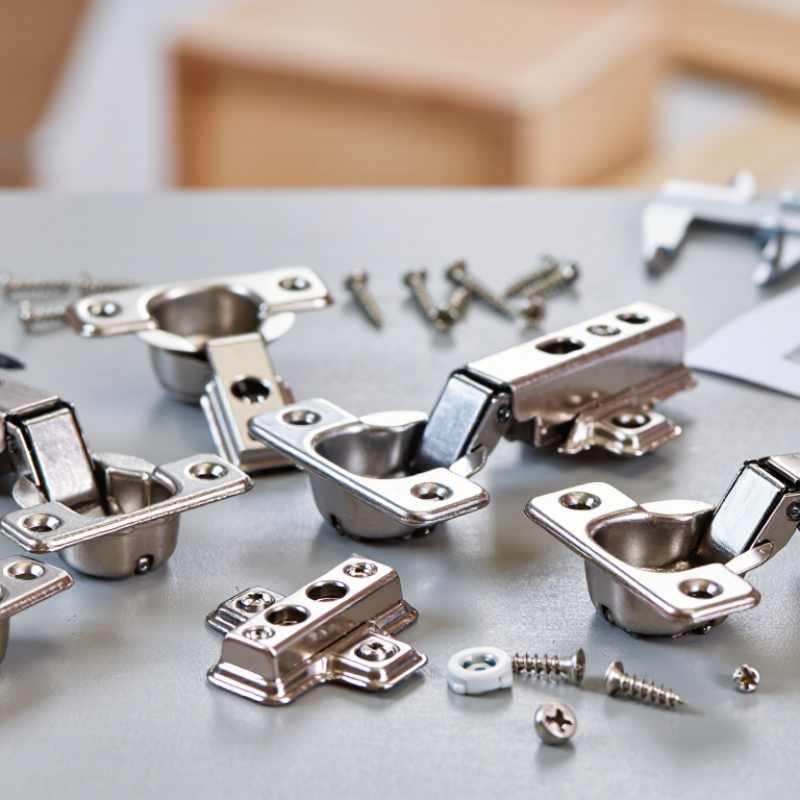
| 1 | Match the material to the environment | Cold-rolled steel is common for dry indoor cabinets. Stainless steel, especially grades 304 or 316, offers better corrosion resistance. | Consider humidity, salt exposure, cleaning chemicals, outdoor use, and temperature changes. | Use plated steel for normal indoor applications; select stainless steel for kitchens, coastal areas, healthcare spaces, or damp locations. |
| 2 | Compare corrosion protection | Common finishes include nickel plating, zinc plating, passivation, and powder coating. Corrosion performance depends on the complete finish system, not only the base metal. | Ask for coating thickness, salt-spray test method, test duration, and whether the test applies to the finished hinge. | Request documented corrosion-test results for projects exposed to moisture or aggressive cleaning agents. |
| 3 | Calculate load capacity correctly | A typical light or medium cabinet door may use two hinges, while tall, wide, heavy, or frequently used doors may require three or more. | Check door weight, door height, door width, hinge spacing, screw quality, panel material, and opening frequency. | Do not divide the door weight by the number of hinges without a safety margin; verify the manufacturer’s tested capacity for the complete installation. |
| 4 | Allow a practical safety margin | For procurement planning, a safety factor of approximately 1.5 to 2.0 is commonly considered when actual operating conditions are uncertain. | Include the door, handle, glass, attached accessories, impact loads, and repeated closing forces. | Select a hinge system whose tested rating comfortably exceeds the calculated working load rather than choosing the minimum rating. |
| 5 | Review cycle-life performance | Cabinet hinges may be tested from tens of thousands to hundreds of thousands of opening cycles, depending on design and application. | Confirm the number of cycles, test door weight, opening angle, closing speed, load condition, and acceptance criteria. | For kitchens, hospitality, retail, and commercial furniture, prioritize independently documented high-cycle testing. |
| 6 | Evaluate the hinge mechanism | Concealed hinges may include standard-close, soft-close, self-closing, or push-to-open mechanisms. | Check closing consistency, adjustment range, resistance to slamming, noise level, and performance at different temperatures. | Choose soft-close mechanisms for frequent-use areas where noise reduction and controlled closing are important. |
| 7 | Check adjustment and alignment | Many concealed hinges provide three-way adjustment: side-to-side, height, and depth. Some models offer only limited adjustment. | Verify adjustment range, mounting-plate compatibility, screw access, and the ability to correct minor installation variation. | For export furniture and mass installation, select hinges with clear adjustment features and compatible mounting plates. |
| 8 | Inspect wear-prone components | Springs, pins, connecting arms, dampers, and mounting clips are common wear points. Steel components generally provide higher structural strength than many lightweight alternatives. | Look for excessive play, spring fatigue, damper leakage, clip deformation, and loosening after repeated operation. | Request component material specifications and sample testing before approving large-volume production. |
| 9 | Verify installation compatibility | Important dimensions include cup diameter, cup depth, overlay, opening angle, screw-hole pattern, and mounting-plate height. | Common concealed hinge cup diameters include approximately 26 mm and 35 mm, but cabinet construction determines suitability. | Use production samples to confirm door thickness, drilling position, overlay, clearance, and mounting hardware before placing the final order. |
| 10 | Request complete quality documentation | Useful documents include material declarations, dimensional drawings, load or cycle test reports, coating information, inspection standards, and packaging specifications. | Ensure test results identify the hinge model, test conditions, sample quantity, failure criteria, and inspection date. | Compare suppliers using the same technical requirements and approve a pre-production sample before mass shipment. |