| Linear slat | Parallel raised or recessed ribs; typically vertical or horizontal. | Often supplied as long narrow boards or modular sheets; thickness and width vary by system. | Repeated ribs create shadow lines and a directional visual effect. Panels are commonly fixed to a prepared substrate or batten framework. | Reception areas, corridors, meeting rooms, and feature walls. | Check joint alignment, fixing method, expansion allowances, and whether the specified system is suitable for the intended indoor environment. |
| Fluted panel | Rounded or softly grooved channels with a regular rhythm. | Available in board or sheet formats; profile depth and module size depend on the product. | Curved grooves diffuse light and add texture while maintaining a consistent repeat across the wall. | Hotels, restaurants, retail interiors, and office feature zones. | Review cleaning access, surface finish, seam visibility, and how exposed edges and corners are detailed. |
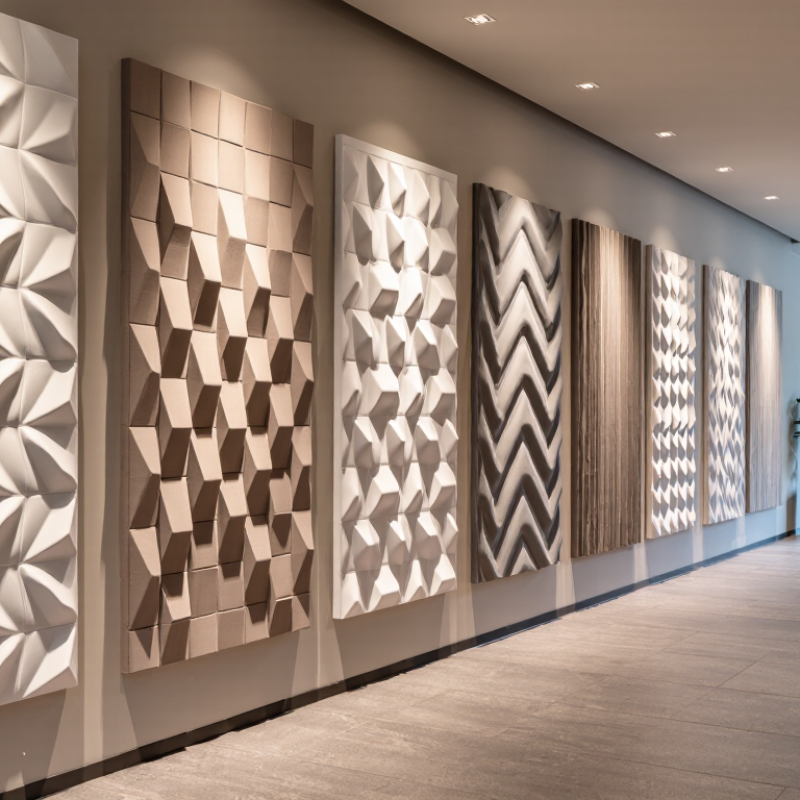
| Geometric relief | Repeating geometric shapes such as squares, diamonds, or angled facets. | Usually modular panels or tiles; dimensions and relief depth are product-specific. | Patterned faces create alternating light and shadow. Accurate layout helps keep the pattern continuous across panel joints. | Lobbies, branded environments without printed logos, hospitality spaces, and presentation walls. | Confirm panel orientation, repeat dimensions, cutting tolerances, and availability of matching trims or corner details. |
| Wave or ripple panel | Continuous undulating ridges and valleys. | Panel or sheet formats; curvature and profile depth vary by design. | Curved relief changes appearance with viewing angle and lighting, making surface preparation and consistent installation especially important. | Feature walls in lounges, reception spaces, and retail interiors. | Assess directional lighting, dust-cleaning needs, panel-to-panel transitions, and whether the relief suits the room scale. |
| Brick or block effect | Raised rectangular units or recessed mortar-like lines. | Typically modular sheets or panels designed to create a repeating masonry-inspired pattern. | Moulded relief provides a masonry-like appearance without using individual masonry units; joints between sheets need careful alignment. | Cafés, casual dining areas, retail fit-outs, and amenity spaces. | Check pattern repeat, edge matching, cleaning instructions, and suitability for the expected impact and traffic level. |
| Wood-grain embossed panel | Textured grain with shallow raised lines or knots. | Commonly offered as boards or panels in multiple surface colors and textures. | Embossing adds tactile texture to a wood-look finish; the composite construction can provide more consistent dimensions than solid timber, depending on the product. | Offices, hotel interiors, retail spaces, and shared amenity areas. | Review color consistency, scratch resistance, cleaning guidance, and any limits on use near heat or moisture. |
| Deep-relief accent panel | Pronounced sculpted forms, layered facets, or irregular relief. | Usually made as decorative modules; relief depth, dimensions, and weight must be checked for each product. | Strong surface projections create a focal point through pronounced shading. A suitable substrate and fixing system are important for secure installation. | Small feature zones, reception backdrops, and hospitality accents. | Verify panel weight, fixing requirements, edge protection, maintenance access, and fire-test documentation for the complete wall assembly. |