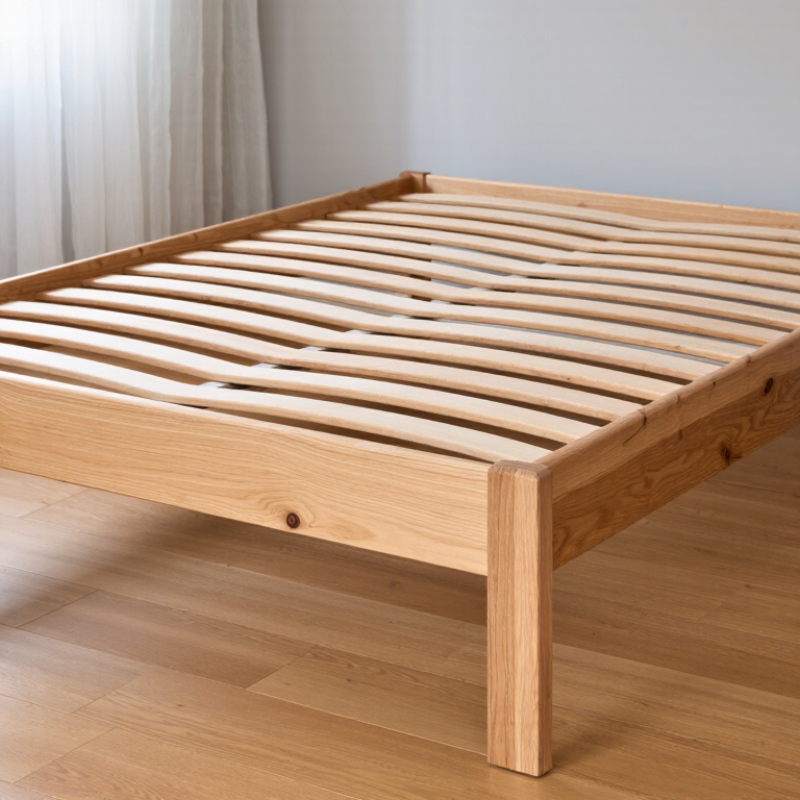
| Typical construction | Solid or laminated wood boards, often supported by side rails or a center beam. | Steel or other metal bars, commonly flat or tubular, supported by side rails and sometimes a center beam. |
| Support and flex | Rigid boards provide firm support; curved wooden slats can flex more under load. | Rigid steel slats generally flex less, though thin or widely spaced bars may bend or shift. |
| Durability considerations | Can crack, split, or warp if overloaded, poorly supported, or exposed to moisture. Slat thickness and support design matter. | Can resist cracking, but may bend, loosen, or corrode if damaged or used in a damp environment. Welds and joints also matter. |
| Ease of assembly | Often straightforward when slats rest on rails; individual slats may need to be positioned or secured. | Often straightforward when bars clip or bolt into place; some designs require alignment and tightening of multiple fasteners. |
| Noise over time | May creak where wood contacts the frame or where joints loosen. | May squeak or rattle where metal parts rub or fasteners loosen; tightening connections can help. |
| Mattress compatibility | Check the mattress maker’s required slat spacing and support instructions, especially for foam mattresses. | Check spacing and support instructions as well; narrow bars do not automatically guarantee adequate mattress support. |
| Maintenance | Inspect for splits, warping, and loose supports; keep the frame dry. | Inspect fasteners and joints; check for bent bars or signs of corrosion. |
| Best suited to | Buyers who prefer a traditional appearance or want the option of rigid or flexible wooden slats. | Buyers who prefer a metal construction and want slats that are typically easy to wipe clean. |
| What to verify before buying | Wood type, slat thickness, center support, maximum load rating, spacing, and replacement-part availability. | Metal type and finish, bar shape and spacing, center support, maximum load rating, and joint design. |
| Buying note: Neither material is automatically more durable. Frame design, material quality, center support, assembly, and the stated load rating all affect performance. Follow the mattress manufacturer’s support and slat-spacing requirements; recommendations vary by mattress. |