| Low Platform Bed | Young children transitioning from a toddler bed; usually about 3–6 years | Twin: 38 × 75 in
(96.5 × 190.5 cm) | Approximately 40 × 77 in
(102 × 196 cm) | At least 8 × 9 ft
(2.4 × 2.7 m) | Low sleeping height, rounded edges, stable slats, and no large gaps between the mattress and frame | Typically 200–300 lb
(91–136 kg); verify the frame rating | Easy floor access can support independent bedtime routines; a simple frame has fewer parts to loosen | Small bedrooms and floor plans that need open walking space |
| Guardrail Twin Bed | Early school years through preteen years; commonly about 4–10 years | Twin: 38 × 75 in
(96.5 × 190.5 cm) | Approximately 40 × 78 in
(102 × 198 cm) | At least 8 × 9 ft
(2.4 × 2.7 m) | Secure guardrail, smooth surfaces, sturdy ladder-free access, and a properly fitted mattress | Typically 200–400 lb
(91–181 kg); check the product documentation | Full-length side protection can reduce rolling out while preserving a familiar single-bed layout | Shared children’s rooms and standard rectangular bedrooms |
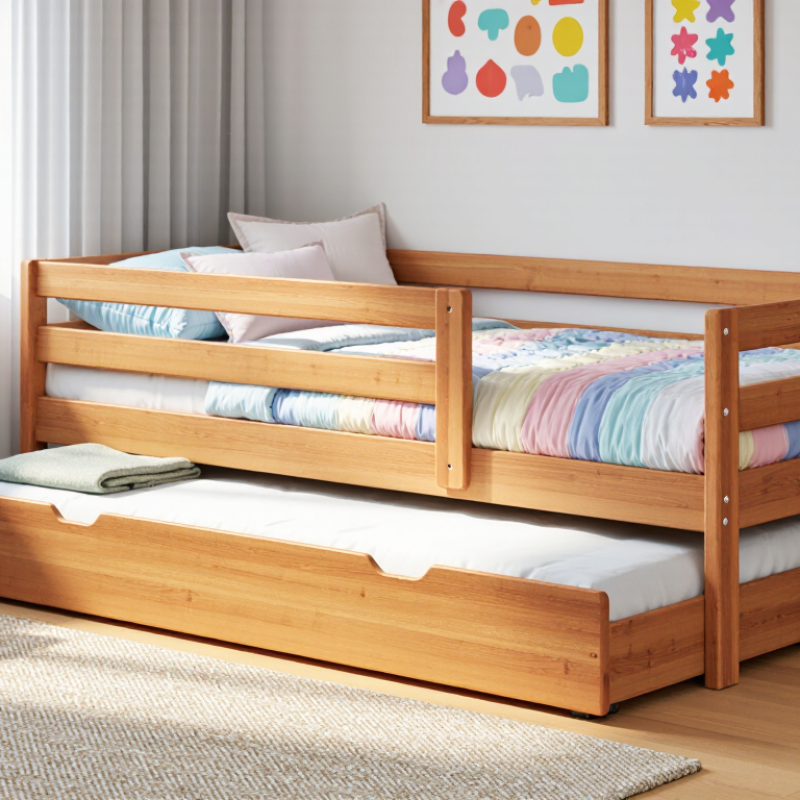
| Twin Trundle Bed | School-age children and occasional sleepovers; about 5–12 years | Two Twin mattresses:
38 × 75 in each | Approximately 40 × 78 in closed; about 78 × 78 in when extended | At least 9 × 10 ft
(2.7 × 3.0 m), with clearance for the trundle | Locking casters, smooth pull-out action, adequate ventilation, and a trundle mattress within its height limit | Approximately 200–300 lb per sleeping surface; verify both frame ratings | Provides a second sleeping surface without permanently occupying the room’s floor area | Guest rooms, shared rooms, and rooms with flexible floor space |
| Storage Bed With Drawers | School-age children through teenagers; about 6–16 years | Twin: 38 × 75 in
or Full: 54 × 75 in | Twin: approximately 41 × 78 in
Full: approximately 57 × 78 in | At least 9 × 10 ft for Twin; 10 × 10 ft for Full | Anti-tip hardware, drawer stops, smooth drawer tracks, rounded corners, and secure slat supports | Typically 300–500 lb
(136–227 kg), including mattress and occupants | Built-in drawers reduce the need for separate cabinets and can improve organization in compact rooms | Small rooms where vertical and under-bed storage are important |
| Full-Size Platform Bed | Older children and teenagers; about 8–18 years | Full: 54 × 75 in
(137 × 190.5 cm) | Approximately 56 × 78 in
(142 × 198 cm) | At least 10 × 10 ft
(3.0 × 3.0 m) | Strong center support, closely spaced slats, rounded corners, and a mattress that does not slide | Typically 400–600 lb
(181–272 kg); confirm the stated limit | Offers more room for growing children and can remain useful into the teenage years | Medium or large bedrooms designed for long-term use |
| Low Loft Bed With Desk | Independent school-age children; commonly about 6–12 years | Twin: 38 × 75 in
(96.5 × 190.5 cm) | Approximately 42 × 80 in
(107 × 203 cm), depending on desk layout | At least 8 × 10 ft
(2.4 × 3.0 m) | Guardrails on exposed sides, secure ladder steps, stable joints, and sufficient ceiling clearance | Typically 200–300 lb
(91–136 kg); follow the age and weight limits | Uses vertical space for sleeping and homework while leaving more open floor area | Compact bedrooms needing a study zone without adding a separate desk |
| Standard Bunk Bed | Older children who can safely use a ladder; commonly about 6 years and older | Two Twin mattresses:
38 × 75 in each | Approximately 42 × 80 in
(107 × 203 cm) | At least 8 × 10 ft
(2.4 × 3.0 m), with safe ladder access | Full-length upper guardrails, secure ladder, strong mattress foundation, and no gaps that could trap a child | Often 200–300 lb per bunk; use the manufacturer’s specific rating | Accommodates two sleepers while preserving central floor space for play and storage | Shared bedrooms with limited floor area and adequate ceiling height |
| Twin XL Bed | Taller preteens, teenagers, and young adults; about 10–18 years | Twin XL: 38 × 80 in
(96.5 × 203 cm) | Approximately 40 × 83 in
(102 × 211 cm) | At least 9 × 10 ft
(2.7 × 3.0 m) | Stable frame, center support, properly fitted longer mattress, and rounded edges | Typically 300–500 lb
(136–227 kg) | Provides 5 additional inches of mattress length compared with a standard Twin for growing children | Narrow rooms where extra length is more useful than extra width |
| Daybed With Back and Side Rails | School-age children through teenagers; about 5–16 years | Twin: 38 × 75 in
(96.5 × 190.5 cm) | Approximately 41 × 80 in
(104 × 203 cm) | At least 9 × 10 ft
(2.7 × 3.0 m) | Stable side rails, no sharp decorative projections, secure slats, and safe clearance from windows | Typically 300–500 lb
(136–227 kg) | Functions as a sofa during the day and a bed at night, helping multipurpose rooms stay organized | Bedrooms that also serve as reading, play, or guest areas |
| Adjustable Split Twin Bed | Older children and teenagers with changing comfort preferences; about 10–18 years | Two Twin XL halves:
38 × 80 in each | Approximately 78 × 83 in when paired | At least 10 × 11 ft
(3.0 × 3.4 m) | Protected moving parts, secured cables, reliable locking mechanisms, and adequate clearance around the base | Usually 300–500 lb per side; verify the adjustable-base rating | Independent head or leg adjustment can support reading and customized comfort; separate halves simplify handling | Larger rooms where flexibility and long-term comfort are priorities |