| RFID Card Lock | A reader identifies an encoded card and releases the motorized or solenoid-driven locking mechanism after authorization. | Contactless RFID cards, commonly operating at 13.56 MHz for modern high-frequency systems. | Guest rooms, staff entrances, meeting rooms, and controlled back-of-house areas. | Fast access, reusable credentials, configurable access rights, and no exposed key slot. | Cards can be lost or damaged; the hotel needs a card-encoding and access-management process. |
| Mobile-Enabled Lock | A smartphone exchanges encrypted access data with the lock, usually through Bluetooth Low Energy, and the lock verifies the digital key locally or through a connected system. | Bluetooth Low Energy in the 2.4 GHz radio band; some systems also support NFC or QR-based workflows. | Digital check-in, premium rooms, serviced apartments, and properties seeking reduced front-desk workload. | Convenient for guests, supports remote credential management, and can integrate with hotel software. | Requires phone compatibility, sufficient battery power, secure software administration, and a fallback access method. |
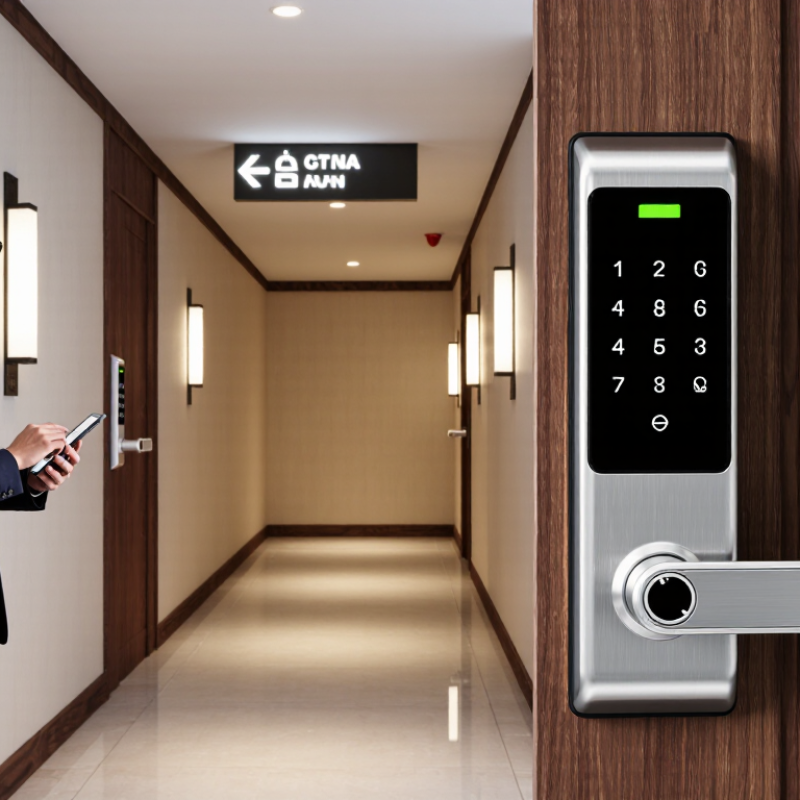
| Keypad PIN Lock | The guest enters an approved PIN; the electronic controller compares it with stored permissions and activates the lock if valid. | Numeric keypad with programmable or time-limited PIN codes. | Small hotels, staff-only areas, storage rooms, short-stay units, and properties without card issuance equipment. | No physical card is required, and codes can be changed without replacing hardware. | PINs may be shared or observed; frequent code management is essential for guest security. |
| Biometric Lock | A sensor captures a biometric feature, such as a fingerprint, and compares it with an enrolled template before granting access. | Fingerprint, facial, or other biometric recognition, depending on the system and local regulations. | Restricted staff areas, executive facilities, laboratories, and high-security rooms rather than general guest rooms. | Users do not need to carry cards or remember PINs; access can be assigned to individuals. | Higher privacy, hygiene, enrollment, and compliance requirements; recognition performance can vary with environmental conditions. |
| Magnetic-Stripe Lock | A magnetic stripe is read when the card is inserted or swiped, and the lock checks the encoded access information. | Magnetic-stripe card with an electronically encoded access period. | Older installations and properties replacing legacy systems in stages. | Established operating method and relatively simple card issuance. | Cards can demagnetize, the reader has moving or exposed contact areas, and security is generally lower than modern contactless systems. |
| Online Networked Lock | The lock communicates with a central access-control platform through a wired or wireless network, allowing permissions and events to be updated centrally. | Ethernet, Wi-Fi, gateway-based wireless communication, or other property network connections. | Large hotels, multi-building properties, staff access points, and facilities requiring real-time monitoring. | Central administration, faster credential cancellation, event monitoring, and easier multi-site management. | Higher installation and network-maintenance requirements; connectivity and cybersecurity must be managed continuously. |
| Offline Electronic Lock | The lock stores access rules locally and validates a card, PIN, mobile key, or other credential without requiring a permanent network connection. | Local memory, programmable credentials, and periodic data transfer through a card, handheld device, or mobile connection. | Independent hotels, guest rooms, retrofit projects, and locations with limited network infrastructure. | Lower infrastructure demand and continued operation during temporary network outages. | Permission changes and event collection may not be immediate unless the lock is periodically synchronized. |
| Typical Power System | Batteries power the reader, controller, indicator, and actuator; the lock normally remains secured when power is unavailable, subject to its fail-safe or emergency design. | Replaceable alkaline or lithium batteries; many residential-style hotel locks use four AA cells, but requirements vary by design. | Most standalone room locks and many retrofit electronic locks. | Avoids dedicated power wiring and simplifies retrofit installation. | Battery life depends on traffic, temperature, credential technology, motor load, and maintenance practices; low-battery alerts are important. |
| Emergency Access Features | A permitted emergency method supplies temporary access or mechanical override while preserving security and, where supported, an event record. | Mechanical override key, external emergency power contacts, authorized service credential, or fire-alarm interface. | Guest rooms, accessible rooms, staff areas, and doors covered by emergency procedures. | Supports guest safety, maintenance access, and business continuity during battery or system problems. | Emergency functions must be coordinated with local fire, accessibility, building, and life-safety requirements. |
| Buyer Evaluation Criteria | Compare the complete door solution rather than the lock body alone, including credential security, software, installation, maintenance, and emergency operation. | Door thickness and preparation, handing, lock case dimensions, communication method, access software, audit trail, battery type, and replacement parts. | New construction, retrofit projects, small independent hotels, large properties, and multi-country deployments. | Improves compatibility, lifecycle planning, guest experience, and total cost control. | Certification and installation requirements differ by country; verify applicable standards such as EN 14846 or ANSI/BHMA requirements with local authorities and qualified installers. |