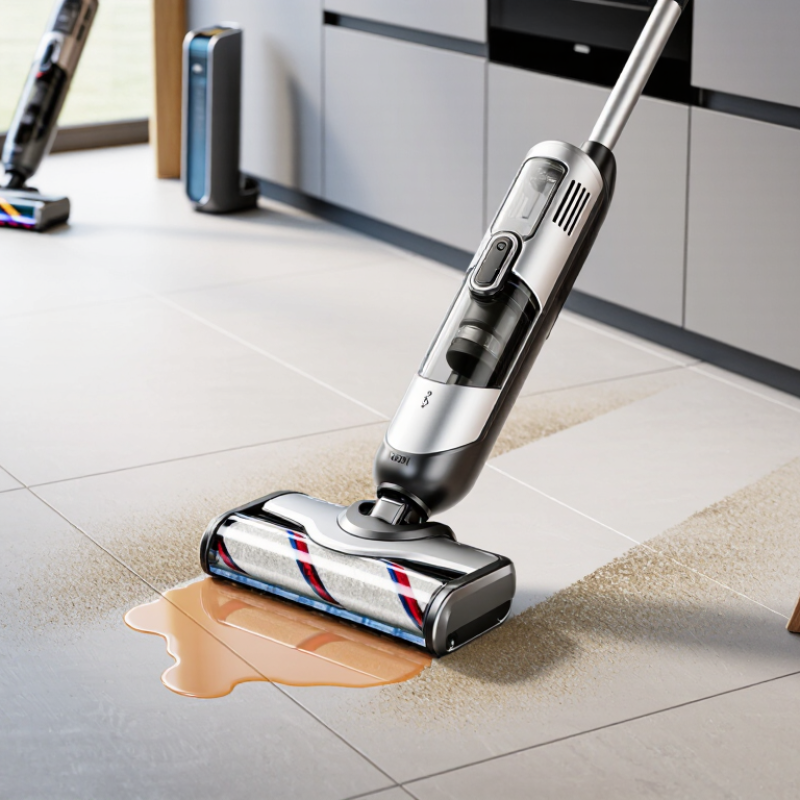
| Mop Type | Dual-roller wet-and-dry floor washer with separate clean- and dirty-water tanks | It can collect liquid debris while washing, reducing the need for separate vacuuming and mopping. | Choose a wet-and-dry model for sealed hard floors and frequent everyday cleaning. | 5/5 |
| Floor Compatibility | Suitable for sealed tile, stone, vinyl, laminate, and properly sealed wood floors | Water exposure and rotating brushes are not appropriate for every surface, especially unsealed wood or delicate flooring. | Confirm the floor-surface list in the product manual before purchase. | 5/5 |
| Cleaning Performance | Powered brush rotation, edge cleaning, and a scraper or comb designed to reduce hair wrapping | Mechanical agitation helps remove sticky marks, dust, food particles, and pet hair more effectively than a passive mop. | Prioritize edge-to-edge cleaning and an easy-to-remove brush roll. | 5/5 |
| Battery Runtime | At least 25–35 minutes in standard cleaning mode | Runtime determines whether a normal cleaning session can be completed without recharging. | 25–35 minutes is generally adequate for apartments and small-to-medium homes; larger homes benefit from a removable battery. | 4/5 |
| Charging Time | Approximately 3–5 hours for a full charge | A shorter charging period improves convenience when the appliance is used frequently. | Look for clear charging indicators and overcharge protection. | 3/5 |
| Clean-Water Tank | Approximately 0.6–0.9 liters | A larger clean-water tank allows more floor area to be cleaned before refilling. | Around 0.7 liters offers a practical balance between capacity and handheld weight. | 4/5 |
| Dirty-Water Tank | Approximately 0.5–0.8 liters, with a full-tank warning | The dirty-water tank must be emptied regularly to maintain suction, hygiene, and odor control. | Choose a removable tank with a wide opening for easier rinsing. | 4/5 |
| Self-Cleaning Function | Automatic brush-rinse cycle after the appliance is returned to its dock | Self-cleaning reduces manual rinsing, although the brush and tank still need to be dried and maintained. | Select a model with brush drying or a clear manual-drying procedure to help limit odors. | 5/5 |
| Noise Level | Preferably below 78 dB during normal operation | Lower noise is more comfortable in open-plan homes and during daytime cleaning. | Check whether the stated noise figure applies to standard mode rather than the highest-power mode. | 4/5 |
| Weight and Maneuverability | Approximately 4–6 kg when empty, with powered forward movement and a flexible handle | Weight and steering affect comfort when cleaning under furniture, around corners, or on larger floors. | Test the turning radius and whether the machine can recline sufficiently for low furniture. | 4/5 |
| Filtration | Washable filter with a separate debris screen or hair filter | Separate filtration helps protect the motor and makes maintenance easier. | Choose washable parts that can be removed without tools and replaced individually. | 4/5 |
| Water and Solution Control | Automatic water dispensing with a clearly stated compatible cleaning-solution policy | Excess water can leave floors wet, while unsuitable detergents may create foam or damage internal components. | Use only the solution recommended in the manual and avoid strong disinfectants unless explicitly permitted. | 5/5 |
| Controls and Display | Simple mode controls, battery indicator, tank warnings, and maintenance reminders | Clear feedback helps prevent operation with an empty clean-water tank or a full dirty-water tank. | A basic display with voice or visual alerts is usually more useful than complex features. | 3/5 |
| Safety | Automatic shutoff for blocked brushes, low water, full dirty-water tank, or abnormal operation | Protective controls reduce the risk of motor damage and unsafe use. | Verify electrical safety documentation and the correct plug and voltage for the destination country. | 5/5 |
| Maintenance Requirements | Removable brush roll, washable filter, accessible tanks, and drying storage | Regular cleaning is necessary because wet debris and hair can cause odor, clogging, and reduced performance. | Choose a design in which the brush, filter, and dirty-water tank can be cleaned without special tools. | 5/5 |
| Replacement Parts | Brush rolls, filters, tanks, batteries, and charging components available for the expected service period | Consumable parts determine the practical lifespan of the appliance. | Ask for a written parts list, estimated availability, and delivery time before ordering. | 5/5 |
| Warranty and Support | Written warranty terms, troubleshooting instructions, and a reachable service contact | After-sales support is especially important for batteries, pumps, motors, and electronic controls. | Prefer clear warranty coverage and documented procedures for repairs or replacement. | 5/5 |
| Overall Recommendation | Wet-and-dry cordless floor washer with self-cleaning, 25–35 minutes of runtime, separate tanks, and accessible replacement parts | This combination offers a useful balance of cleaning ability, convenience, maintenance, and long-term ownership value. | For most homes, prioritize reliability, floor compatibility, maintenance, and support over extra smart features. | Best Overall |