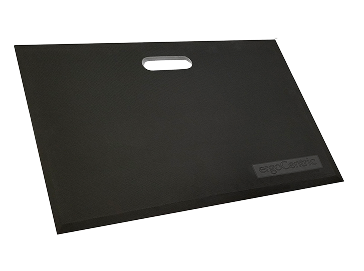
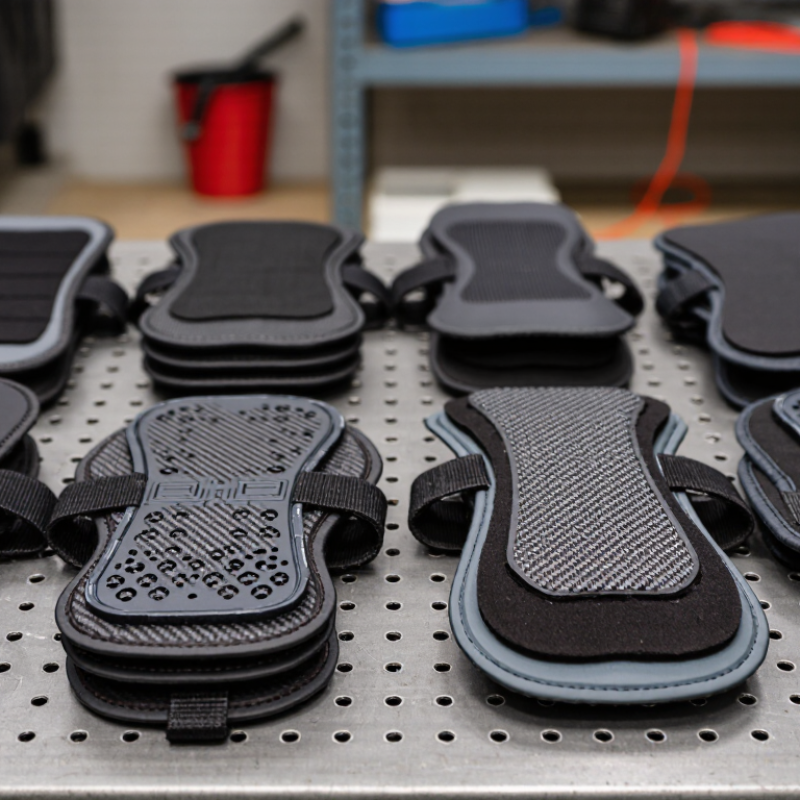
| 1 | Carbon-Fiber Knee Training Pad | Floor-level assembly, maintenance kneeling, and practical safety training | Woven carbon-fiber shell over impact-absorbing polymer foam | 12–20 mm | Hard outer shell, adjustable straps, and replaceable cushioning insert | Wipe with mild detergent; air-dry; inspect shell, stitching, and straps before use | ASTM F1771 may be relevant where the product is designed and tested as occupational knee protection; OSHA 29 CFR 1910.132 requires hazard assessment, proper selection, fit, training, and maintenance | Request material declarations for polymers, dyes, coatings, and adhesives; check restricted substances under REACH and RoHS where the product falls within applicable electrical/electronic equipment scope | Include kneeling hazards, PPE selection, worker training, inspection, and replacement criteria in the OH&S process |
| 2 | Carbon Composite Elbow Pad | Pipework, confined-space simulation, and mechanical maintenance training | Carbon-reinforced thermoplastic cap with closed-cell foam liner | 8–15 mm | Low-profile protection with flexible hinge zones for climbing and crawling drills | Clean after each session; do not use solvents that can attack the polymer or adhesive | Use applicable impact or protective-pad test methods; OSHA requires the employer to assess contact, impact, and ergonomic hazards before issuing PPE | Obtain supplier declarations for intentionally added substances and homogeneous materials; retain supporting test reports | Link the pad to task risk assessments, competency training, pre-use checks, and corrective-action records |
| 3 | Carbon-Fiber Shin and Instep Pad | Warehouse, logistics, fabrication, and material-handling demonstrations | Carbon-fiber laminate or carbon-reinforced polymer with foam backing | 10–18 mm | Coverage of the shin and instep with adjustable hook-and-loop retention | Remove loose debris; wash removable liners according to their care instructions; replace damaged retention parts | ASTM F2413 applies to compliant protective footwear, not automatically to separate shin pads; document the specific test basis used for the pad | Verify REACH candidate-list communication duties and restricted-substance controls; RoHS is generally equipment-scope dependent and is not a blanket requirement for standalone PPE | Use documented PPE issue records, user instruction, storage controls, and periodic effectiveness reviews |
| 4 | Carbon Chest and Rib Training Protector | Heavy-equipment training, rescue drills, and controlled impact simulations | Segmented carbon-composite plates mounted on a textile carrier with energy-absorbing foam | 15–25 mm | Broad torso coverage, segmented movement, and adjustable shoulder and waist straps | Inspect plate edges and carrier seams; clean by hand; dry completely before storage | Do not treat the pad as certified merely because it uses carbon fiber; identify the applicable impact standard and retain laboratory evidence for the intended hazard | Screen coatings, plasticizers, flame retardants, and adhesives; obtain current supplier compliance statements because chemical requirements can change | Control simulated-impact limits, instructor authorization, medical considerations, and incident reporting within the management system |
| 5 | Carbon Shoulder and Collar Pad | Overhead-work practice, lifting operations, and confined-area movement exercises | Thin carbon-reinforced shell with molded foam and textile shoulder harness | 8–14 mm | Reduced snag profile and shoulder mobility for repeated training movements | Check harness adjustment points and foam compression; store flat and away from excessive heat | OSHA 29 CFR 1910.132 requires PPE to be appropriate to the identified hazard; a carbon shell alone does not establish protection against electrical, chemical, or fall hazards | Confirm chemical declarations for shell resin, foam, textile treatments, and fastening components; assess whether any electronic accessory triggers RoHS scope | Address overhead hazards, manual-handling controls, user feedback, and fit verification in training records |
| 6 | Carbon Back and Spine Training Pad | Industrial rescue, crawling, ladder, and emergency-response drills | Flexible segmented carbon-composite panels with a ventilated foam carrier | 14–22 mm | Spinal-area coverage while permitting bending and controlled crawling | Inspect segment joints, foam, and carrier; remove from service after cracks, delamination, or severe deformation | Specify the intended injury mechanism and test method; ASTM and OSHA requirements must be matched to the actual PPE category and workplace hazard | Maintain a technical file containing bills of materials, declarations, and test evidence for restricted substances | Use scenario risk assessments, drill controls, equipment inspection intervals, and continual-improvement reviews |
| 7 | Carbon Wrist and Forearm Pad | Tool-use practice, repetitive assembly, and hand-protection demonstrations | Carbon-reinforced polymer guard with flexible textile and foam cuff | 6–12 mm | Lightweight forearm coverage with a contoured wrist transition | Clean and dry after use; verify that the cuff does not restrict circulation or tool control | Do not substitute this pad for cut-, puncture-, chemical-, or electrical-protective gloves unless the complete product is specifically tested and rated for that hazard | Review dyes, coatings, elastomers, adhesives, and metal hardware against current REACH restrictions; RoHS applies only when relevant product scope is met | Include ergonomic suitability, tool-control checks, worker consultation, and near-miss feedback |
| 8 | Carbon Impact-Panel Training Vest | Vehicle-yard, construction, and controlled collision-avoidance training | Removable carbon-composite panels in a high-visibility textile vest | 10–18 mm | Modular front, back, and side panels with high-visibility carrier options | Remove panels before laundering unless the manufacturer permits washing; inspect reflective elements and closures | High-visibility clothing and impact protection are separate performance claims; verify each claim against its applicable standard rather than relying on a general ASTM label | Check textile chemicals, coatings, reflective films, plastic parts, and fasteners; preserve supplier documentation by batch or material lot | Combine traffic-management procedures, PPE training, visibility checks, and post-exercise evaluations |
| 9 | Carbon Composite Training Glove Insert | Mechanical-handling demonstrations and controlled hand-impact exercises | Small carbon-composite inserts integrated into a compatible glove design | 3–8 mm | Localized knuckle or back-of-hand coverage with preserved dexterity | Follow the glove manufacturer’s cleaning instructions; inspect insert edges and stitching for exposure | Evaluate the complete glove assembly, not only the carbon insert; separate tests may be needed for impact, cut, puncture, heat, or chemical resistance | Request declarations covering leather or textile materials, polymer coatings, adhesives, dyes, and insert composition | Document task-specific selection, glove fit, dexterity checks, replacement rules, and worker training |
| 10 | Carbon Modular Full-Body Training Kit | Multi-hazard drills requiring interchangeable knee, elbow, torso, and limb modules | Interchangeable carbon-composite shells with foam liners and textile harnesses | 8–25 mm, depending on module | Configurable coverage, replacement components, and size-adjustable harness system | Use a module-by-module inspection checklist; quarantine cracked, delaminated, or poorly retained components | Each module requires a hazard-specific conformity and test review; ISO 45001 is a management-system standard and does not certify the kit’s protective performance | Maintain a complete bill of materials and current REACH/RoHS applicability assessment for every module and accessory | Best suited to a controlled PPE program covering procurement, training, inspection, incident learning, and management review |