20% off Demo Text

2026 Best Industrial Counter Stools for Global Buyers

Choosing the right Industrial Counter Stool in 2026 requires more than comparing photos and prices. Global buyers need dependable construction, suitable dimensions, and clear supplier information. A stool may look impressive online, yet feel unstable beside a 90-centimeter counter. Small details matter.

This guide examines industrial counter stools through practical buying experience and professional product evaluation. We consider seat height, frame strength, welding quality, surface finish, and long-term comfort. Steel frames should resist daily movement, while wood seats need smooth edges and consistent moisture protection. Footrests should support natural posture without creating sharp pressure points. We also review packaging, assembly instructions, sample approval, and communication with manufacturers. These details often decide whether a shipment succeeds.

Safety remains essential. Buyers should request material specifications, load testing evidence, and relevant compliance documents for their destination market. Requirements can differ between regions, so one certificate may not answer every purchasing concern. A reliable supplier explains limitations instead of making vague promises. That builds trust.

No shortlist is perfect. User preferences, climate, shipping conditions, and commercial environments can change the final choice. Some attractive finishes may show fingerprints quickly. Some lightweight models may sacrifice stability. We will point out these weaknesses where possible, rather than presenting every product as flawless. The aim is a clearer buying decision for restaurants, cafés, hotels, offices, and residential projects worldwide. Expect practical comparisons, realistic observations, and questions worth asking before placing a large order.

2026 Best Industrial Counter Stools for Global Buyers

Industrial Counter Stools: Definition, Purpose, and Key Features

2026 Best Industrial Counter Stools for Global Buyers

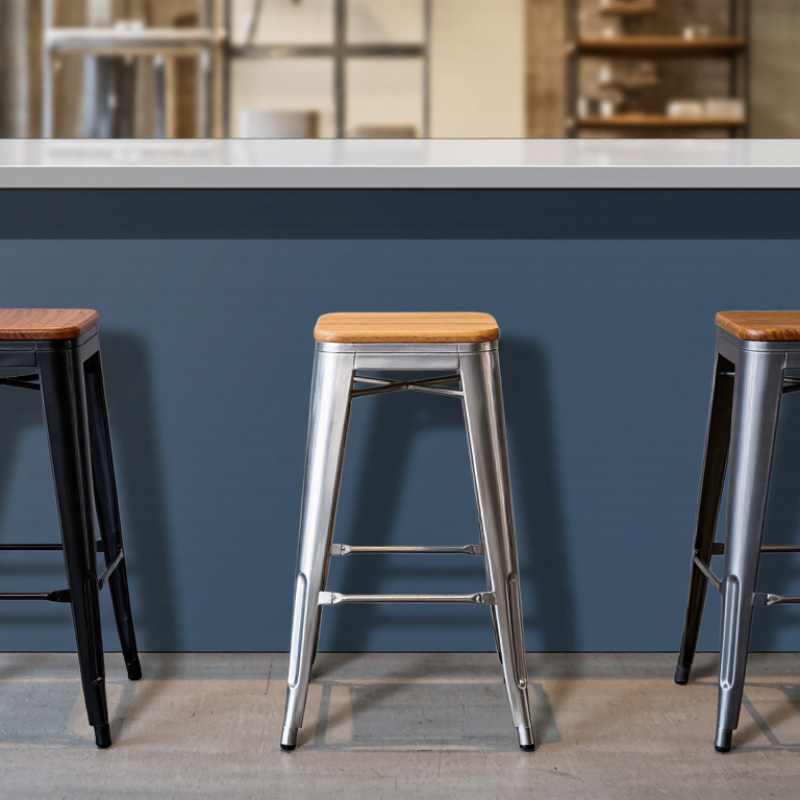
Industrial counter stools combine practical seating with a workshop-inspired appearance. They usually feature metal frames, wood or engineered seats, and visible structural details. Their purpose is simple: provide comfortable support at counters, kitchen islands, cafés, bars, and commercial workspaces.

A reliable stool should match the counter height closely. Most counter stools suit surfaces around 34 to 36 inches high. Allow about 9 to 12 inches between the seat and countertop. Key features include a stable four-leg or sled base, reinforced joints, a supportive footrest, and a durable finish. Powder-coated metal can resist scratches and everyday wear. Solid wood adds warmth, but its surface needs proper sealing. Swivel seats improve movement, although they may require stronger hardware and more maintenance. Backrests support longer sitting periods. Backless designs save space but may feel less comfortable.

Tips: Measure before ordering. Check seat height, frame width, weight capacity, and packaging protection. Ask suppliers for material details, load-testing information, and finish samples. Small defects often appear at welds or seat edges, so inspect samples carefully. Climate matters too; humid regions may need better corrosion protection. We have seen attractive stools fail because buyers ignored floor conditions. A rubber foot can protect tile, yet it may slide on polished concrete. No design suits every project. Practical testing still matters.

Materials, Construction, and Durability Standards for 2026

Materials, Construction, and Durability Standards for 2026

Industrial counter stools in 2026 need more than a rugged appearance. Commercial buyers should inspect the material’s behavior under moisture, abrasion, and repeated loading.

Powder-coated steel resists corrosion better than untreated mild steel, while solid hardwood requires sealed end grain and stable joinery. For upholstered seats, high-density foam and abrasion-tested fabrics matter. The 2024 Global Furniture Outlook from CSIL identifies commercial replacement demand as a major purchasing factor, making service life financially important.

Construction details reveal real quality. Look for continuous welds, reinforced seat plates, protected fasteners, and level-adjusting glides. A 360-degree footrest should connect securely to the frame, not merely sit on thin tubing.

ANSI/BIFMA seating tests commonly use 100,000-cycle durability benchmarks and a 275-pound static load reference.

However, this benchmark mainly covers office seating. Buyers should request test evidence aligned with the stool’s actual category. That distinction is often missed.

ISO 7173 evaluates seating strength and durability, while EN 16139 addresses non-domestic seating performance. Ask suppliers for test dates, sample descriptions, load values, and failure records.

Certification without traceable documentation is weak evidence. Very weak.

Also check corrosion testing, such as salt-spray exposure, when stools enter kitchens or humid facilities. I would not accept a thick finish alone as proof of durability.

A slightly imperfect weld may survive, but repeated commercial use can expose it quickly. Inspect the underside, especially around footrest joints and mounting points.

Counter Stool Styles for Industrial and Commercial Environments

Industrial and commercial counter stools in 2026 must balance visual character with daily performance. In cafés, showrooms, hotel bars, and workplace canteens, style affects traffic flow and customer comfort. Metal frames create a practical workshop appearance, while molded seats soften hard interiors. Reclaimed-looking wood adds warmth, although its surface may show scratches sooner. That is not always a defect. It can support an honest, used aesthetic.

Backless stools suit narrow counters and slide completely underneath. Low-back designs provide modest support without blocking sightlines across open dining areas. Full-back stools feel more residential and work well in hospitality spaces with longer stays. Swivel versions improve movement, but their mechanisms require careful inspection. A fixed frame is often quieter and easier to maintain. Seat height must match the counter, not the product photograph. Measure the finished floor-to-counter distance before ordering. For many counters, a seat near 24 to 26 inches works, but construction standards and user needs can differ.

Commercial buyers should examine welds, edge finishing, footrests, and cleanability. Rounded corners reduce snagging and make wiping faster during busy service. Powder-coated steel handles frequent use, yet damaged coatings can expose metal in humid locations. Specify replacement glides and hardware before shipment. This detail saves time later. Global projects also need clear packaging, assembly instructions, load-testing data, and material documentation. Some stools look excellent online but feel rigid after ten minutes. A sample review with staff and real users may reveal that the most fashionable option needs reconsideration.

2026 Best Industrial Counter Stools for Global Buyers

Typical commercial stool heights vary by application. Counter stools generally suit worktops around 89–94 cm high, while bar and spectator stools are designed for progressively taller surfaces. Seat height, foot support, durability, and cleanability should be matched to the intended industrial or commercial environment.

How Global Buyers Should Compare Sizes, Comfort, and Safety

Global buyers should compare industrial counter stools by fit, not appearance alone. A typical counter is 86–91 centimetres high, so a 61–66 centimetre seat usually leaves practical legroom. Measure the finished counter, including its edge and apron. Otherwise, knees may press against the underside.

Comfort affects work quality. The World Health Organization reports that musculoskeletal conditions affect about 1.71 billion people worldwide. A firm, contoured seat, supportive footrest, and stable backrest can reduce pressure during long shifts. Look for rounded front edges and breathable surfaces. Soft padding feels attractive, but it may flatten quickly in workshops. That is an easy detail to overlook.

Tips: Request dimensional drawings, load-test evidence, and cleaning instructions before ordering. Check seat height in millimetres, not vague terms like “standard.” For safety, review BIFMA X5.4 testing references and ask whether the stool passed stability, strength, and durability evaluations. Four feet may feel safer, yet poor floor contact creates wobble. Test samples on uneven flooring when possible. I would not rely on photographs alone. A stool can look solid and still fail under repeated twisting, tool-belt contact, or careless sitting.

Sourcing, Customization, Pricing, and International Shipping Factors

2026 Best Industrial Counter Stools for Global Buyers

Industrial counter stools need more than a strong steel frame. Global buyers should verify seat height, weld quality, load testing, finish durability, and packaging before ordering. ANSI/BIFMA X5.4 provides recognized barstool testing methods, including stability and strength requirements. Ask suppliers for recent test records, not only product photos. Measure twice.

Customization affects both price and lead time. Buyers can select seat materials, powder-coat colors, footrest shapes, stackability, and protective floor glides. However, small changes may require new tooling or revised cartons. A useful quotation should separate product cost, tooling, packaging, inspection, and minimum order quantity. I would avoid choosing the lowest unit price; thin packaging can create expensive damage claims.

International shipping needs a landed-cost calculation. UNCTAD’s Review of Maritime Transport 2024 notes that more than 80% of world merchandise trade by volume moves by sea. Freight rates, port handling, customs duties, insurance, and destination delivery can therefore reshape the final budget. The World Bank’s 2023 Logistics Performance Index also highlights differences in customs speed and shipment reliability between markets. Use moisture-resistant cartons, corner protection, and carton drop testing. Freight changes everything. A realistic purchase plan should include buffer time, because even experienced buyers sometimes underestimate port delays and seasonal congestion.

2026 Best Industrial Counter Stools for Global Buyers - Sourcing, Customization, Pricing, and International Shipping Factors

Stool Type Typical Construction Recommended Seat Height Indicative Factory Price* Typical MOQ Customization Options Durability and Maintenance Packaging and Shipping Factors Best Application Buyer Checkpoints
Metal Backless Stool Steel or stainless-steel frame with a round, square, or formed metal seat. 24–26 in / 61–66 cm US$18–45 per unit 50–200 units Seat shape Powder color Foot ring Stacking design Highly resistant to heavy use. Powder coating should be checked for coverage, adhesion, and corrosion protection. Nesting or stacking can reduce cubic volume. Protect seat edges and powder-coated surfaces with separators. Workshops, cafés, bars, kitchens, laboratories Check weld quality, levelness, load rating, and floor-protection feet.
Metal Stool with Wood Seat Steel frame combined with solid wood, plywood, or veneered wood seat. 24–26 in / 61–66 cm US$28–65 per unit 50–150 units Wood species Stain color Seat profile Frame finish Warm appearance with good commercial durability. Wood requires a sealed surface and protection from prolonged moisture. Wood components need moisture-resistant packing. Mixed materials may require additional corner and edge protection. Restaurants, retail counters, hospitality interiors Confirm wood moisture level, color consistency, formaldehyde documentation, and finish durability.
Industrial Upholstered Stool Steel frame with plywood or molded seat shell, foam padding, and textile or synthetic leather cover. 24–26 in / 61–66 cm US$35–85 per unit 50–100 units Fabric grade Foam density Piping Stitching Comfortable for longer seating periods. Commercial-grade coverings should be tested for abrasion, colorfastness, and cleanability. Use dust covers and compression-resistant cartons. Avoid excessive stacking that may deform cushions. Hospitality, coworking spaces, showrooms, dining areas Request abrasion results, stain-cleaning instructions, seam inspection, and color approval samples.
Adjustable-Height Industrial Stool Steel base with threaded, pneumatic, or mechanical height-adjustment mechanism. Approx. 23–31 in / 58–79 cm US$45–110 per unit 50–100 units Adjustment range Base type Seat material Footrest Versatile, but moving parts require functional testing. Load capacity and cycle testing are important for commercial use. Mechanisms increase weight and carton size. Lock moving parts and protect levers during export handling. Workbenches, studios, laboratories, flexible counters Verify adjustment cycles, stability at maximum height, spare-part availability, and operating instructions.
Swivel Industrial Counter Stool Steel frame or pedestal base with a rotating seat and optional return-memory mechanism. 24–26 in / 61–66 cm US$42–100 per unit 50–100 units 360° swivel Return memory Seat shell Base finish Provides convenience in commercial environments. The swivel plate and fasteners should be checked for looseness after cycle testing. Secure the swivel assembly and use reinforced cartons. Component separation may reduce scratching during transit. Bars, cafés, reception counters, entertainment venues Test rotation smoothness, noise, return function, fastener torque, and anti-tip stability.
Stackable Industrial Stool Reinforced steel or aluminum frame designed for vertical stacking and frequent relocation. 24–26 in / 61–66 cm US$25–60 per unit 50–200 units Stack height Seat material Linking system Color Efficient for high-volume use and storage. Stacking points should not damage the coating or seat surface. High packing efficiency can reduce freight volume. Confirm maximum safe stack quantity before delivery. Event venues, training rooms, food service, retail storage Check stack alignment, anti-scratch buffers, frame strength, and safe handling instructions.
Outdoor-Ready Industrial Stool Galvanized or treated steel, aluminum, or stainless steel with weather-resistant seat materials. 24–26 in / 61–66 cm US$40–105 per unit 50–100 units UV-resistant finish Drainage holes Stainless hardware Outdoor colors Suitable for covered or exposed areas when correctly specified. Corrosion resistance depends on material, coating, and environment. Prevent trapped moisture inside packaging. Export cartons should include ventilation considerations and corrosion protection where needed. Patios, outdoor cafés, garden counters, leisure facilities Define climate exposure, salt-air conditions, UV requirements, drainage, and corrosion-test expectations.
Recycled-Material Industrial Stool Metal frame with recycled plastic, recycled wood composite, or reclaimed-material seat components. 24–26 in / 61–66 cm US$32–90 per unit 50–150 units Material percentage Color blend Surface texture Documentation Performance varies by recycled material. Inspect dimensional stability, surface consistency, and resistance to moisture and impact. Material density affects freight weight. Request recycled-content and packaging documentation before finalizing specifications. Sustainable commercial interiors, educational spaces, retail projects Verify recycled-content claims, chemical compliance, batch consistency, and end-of-life information.
Heavy-Duty Workshop Stool Reinforced steel frame, thick seat, broad foot ring, and high-strength welds or bolted joints. 24–26 in / 61–66 cm US$38–95 per unit 25–100 units Higher load rating Seat thickness Tool tray Foot ring Designed for demanding environments. Specify a tested working load rather than relying only on static frame appearance. Heavier construction increases ocean and air freight charges. Use reinforced cartons and palletized loading for large orders. Factories, repair shops, technical classrooms, maker spaces Request load-test method, weld inspection, hardware grade, anti-slip feet, and replacement-part options.
Flat-Pack Industrial Stool Knock-down steel or mixed-material construction using bolts, inserts, or simple assembly hardware. 24–26 in / 61–66 cm US$22–58 per unit 100–300 units Assembly method Hardware kit Carton design Instructions Reduces storage and shipping volume. Long-term performance depends on joint design and correct assembly torque. Often lowers cubic shipping cost. Include labeled hardware, assembly tools where needed, and multilingual instructions. E-commerce, project rollouts, budget-conscious commercial buyers Review carton drop tests, assembly time, spare hardware, replacement policy, and delivered cost.
*Indicative factory price ranges are planning estimates in USD per unit for standard specifications, excluding tooling, taxes, duties, inspection, inland delivery, and international freight. Actual quotations vary by order quantity, materials, finish, certification, customization, origin, destination, and Incoterms.