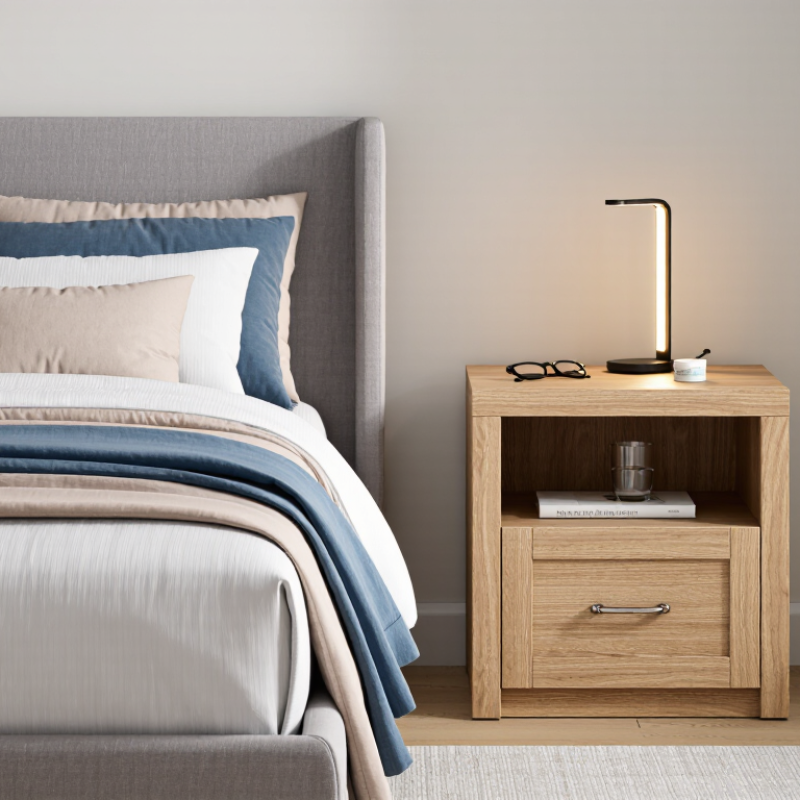
| Reach height for frequently used items | Keep controls and everyday items within 15–48 in (38–122 cm) above the floor where feasible. | The ADA Standards specify this range for accessible reach to operable parts in applicable settings; it is a useful planning reference, not a bedside-cabinet height requirement. | Check the height of the lamp switch, phone, glasses, and drawer pull—not just the cabinet top. |
| Cabinet-top height | Choose a top close to mattress height, then test it from the user’s usual seated or lying position. | Mattress heights and users’ mobility vary, so there is no single universally suitable bedside-cabinet height. | Confirm that items can be reached without excessive stretching, twisting, or leaning over the bed edge. |
| Reach over an obstruction | For an applicable forward reach over an obstruction, ADA maximum reach height is 48 in (122 cm) when the obstruction is no more than 20 in (51 cm) deep; it is 44 in (112 cm) when depth is 20–25 in (51–64 cm). | A bed, cabinet, or other obstruction can affect the permitted maximum reach height under the ADA reach provisions. | Measure the obstruction depth and consult the applicable standard when designing an accessible space. |
| Clear approach beside the bed | Preserve the space needed for the user, mobility device, and transfer; the required layout depends on the applicable accessibility standard and room plan. | A reachable cabinet is not useful if a wheelchair or walker cannot approach it safely. | Check the full route and transfer area, not only the gap between the bed and cabinet. |
| Drawer and door operation | Look for pulls that are easy to grasp and operate without tight pinching or twisting. | Simple, low-effort operation can make frequently used storage easier to access. | Test each drawer and door from the intended position; avoid placing essential items behind difficult-to-open fronts. |
| Stability and tip resistance | Choose a stable cabinet that does not rock during normal use; secure it as directed by its manufacturer when appropriate. | Pulling on a drawer or leaning against a light cabinet may cause it to shift or tip. | Check the base, drawer stops, and installation instructions, especially in homes with children or users who rely on support. |
| Electrical items and cords | Keep cords routed away from walking paths and transfer areas. | Loose cords can create a trip hazard, while accessible switches reduce the need to reach awkwardly. | Position lamps and chargers so cords do not cross the floor or become trapped by drawers. |
| Important standards note | ADA reach ranges apply to specified accessible elements and conditions; they do not set a general required height for residential bedside cabinets. Requirements can depend on the project, applicable code, reach direction, and obstruction. Verify the governing standard for the specific space. |