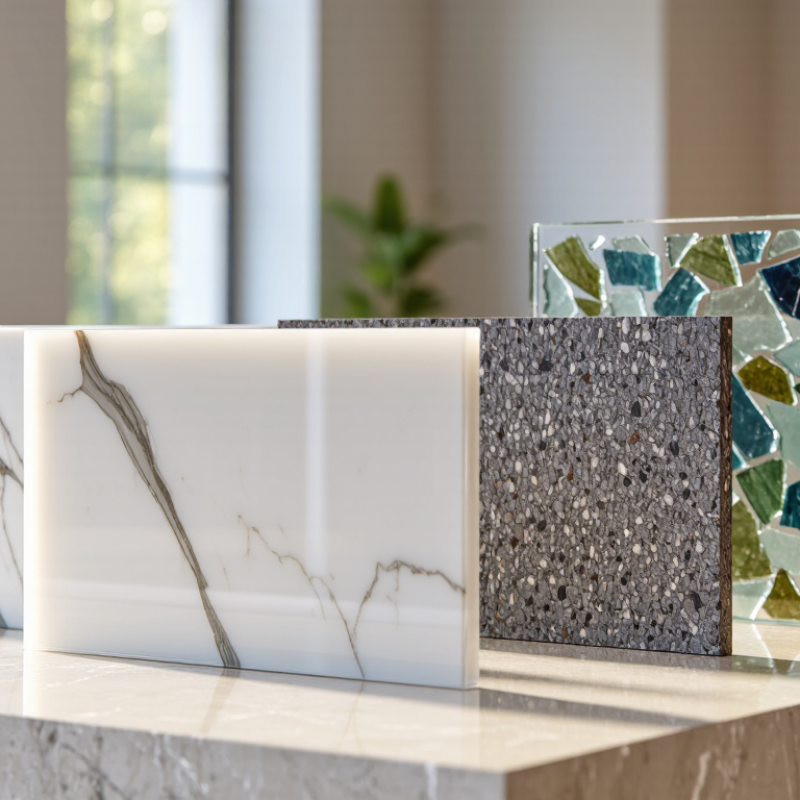
| Engineered Quartz | A factory-produced slab material made by combining mineral aggregates with a polymer binder and pigments. | Usually predominantly quartz aggregate, with resin binder, pigments, and small amounts of additives. | Mixing, vacuum compaction, vibration, pressing, curing, and surface polishing. | High hardness, consistent pattern, low porosity, easy routine cleaning, and good resistance to household staining. Prolonged exposure to high heat can damage the resin binder. | Kitchen countertops Bathroom vanities Wall cladding Reception counters | Uniform appearance, low maintenance, indoor countertop performance, and design consistency. | Medium to high |
| Sintered Stone | A dense stone-like surface produced by compacting and heating selected minerals at very high temperature. | Natural minerals such as feldspathic materials, silica, clays, and other mineral components; generally no conventional resin binder. | High-pressure compaction followed by high-temperature sintering, then cutting and finishing. | Very low water absorption, high resistance to scratching, heat, ultraviolet exposure, and many household chemicals. Large slabs require careful handling and professional installation. | Kitchen worktops Exterior façades Flooring Wall panels Outdoor kitchens | Outdoor durability, heat resistance, color stability, large-format design, and long service life. | Medium to high |
| Porcelain Slab | A large-format ceramic surface made from refined mineral raw materials and fired to achieve a dense, hard body. | Kaolin and other clays, feldspar, silica, mineral pigments, and ceramic additives. | Spray drying, pressing, decoration, and high-temperature kiln firing. | Very low water absorption, strong resistance to ultraviolet light, heat, frost, and abrasion. Cutting and edge fabrication require suitable diamond tools and skilled processing. | Countertops Flooring Bathrooms Ventilated façades Furniture surfaces | Thin large panels, exterior use, hygienic surfaces, and resistance to environmental exposure. | Medium to high |
| Solid Surface | A homogeneous non-porous surfacing material that can be cut, shaped, joined, and refinished during fabrication. | Acrylic or polyester resin, mineral fillers such as alumina trihydrate, pigments, and performance additives. | Resin and filler blending followed by casting or compression molding, curing, cutting, and sanding. | Seamless appearance, repairability, thermoformability in selected grades, and good stain resistance. It is generally more susceptible to scratching and heat damage than dense ceramic or sintered surfaces. | Healthcare counters Retail desks Reception areas Integrated sinks Wall panels | Seamless joints, curved designs, integrated sinks, hygiene-focused projects, and repairability. | Medium |
| Cultured Marble | A molded decorative composite designed to resemble marble and commonly used for sanitary and interior components. | Calcium carbonate or other mineral filler, polyester resin, pigments, gel coat, and surface additives. | Molding, vibration or casting, curing, trimming, and polishing or gel-coat finishing. | Smooth decorative surface, molded shapes, comparatively efficient production, and good suitability for bathroom components. Heat, impact, and chemical performance depends on the formulation and protective finish. | Bathtub surrounds Shower walls Vanity tops Window sills | Bathroom renovation, molded dimensions, coordinated colors, and economical project supply. | Low to medium |
| Cultured Onyx | A translucent decorative composite formulated to imitate the visual effect of natural onyx. | Resin, mineral fillers, pigments, translucent particles, and a protective surface layer. | Casting or molding with controlled pigment distribution, curing, trimming, and polishing. | Decorative veining, color depth, and potential translucency for backlighting. It requires careful protection from abrasion, harsh chemicals, and high-impact use. | Feature walls Hotel counters Bar fronts Lighting panels Decorative furniture | Visual impact, custom colors, backlit interiors, and hospitality or retail decoration. | Medium to high |
| Polymer Concrete | A cement-free or reduced-cement composite in which polymer resin binds mineral aggregates for engineered products. | Mineral aggregates, polymer resin, pigments, fibers, fillers, and curing additives. | Mixing, casting or compression molding, vibration, curing, and surface finishing. | High design flexibility, good dimensional control, lower permeability than many conventional cement products, and suitability for molded architectural components. | Architectural panels Planters Sinks Furniture Landscape elements | Custom shapes, architectural detailing, molded products, and controlled surface finishes. | Medium |
| Cast Stone | A manufactured architectural concrete product designed to reproduce the appearance of cut natural building stone. | Portland cement or other cementitious binder, fine and coarse aggregates, mineral pigments, and admixtures. | Wet casting, dry tamping, vibration, curing, demolding, and surface texturing. | Suitable for architectural detailing, repeatable dimensions, and weather-exposed construction when correctly specified. Performance depends on mix design, curing, reinforcement, and local standards. | Façade trim Columns Window surrounds Masonry units Landscaping | Traditional appearance, repeatable profiles, structural detailing, and compatibility with masonry construction. | Low to medium |
| Glass Aggregate Surface | A decorative composite that incorporates recycled or manufactured glass particles into a cementitious or resin matrix. | Glass aggregate, cementitious or resin binder, pigments, fillers, and surface sealers. | Aggregate blending, casting or pressing, curing, grinding, honing, and sealing. | Distinctive reflective appearance, broad color possibilities, and potential use of recycled glass. Sealing and correct fabrication are important for stain control and surface durability. | Countertops Flooring Wall panels Public interiors Decorative tiles | Recycled-content design, distinctive appearance, decorative projects, and sustainability objectives. | Medium |